by Diego Goller | 25 May 2023 | 2023 Europe Day, Austria, News
Europe Day in Vienna, 6 May 2023. More than 100 people from six Central European countries gathered for the event promoted by ‘Together for Europe – Austria’ in the Schönstatt Centre in Vienna-Kahlenberg.
Under the title ‘Building Bridges of Hope’, ten speakers shared their experiences as ‘bridge builders’. On this day, the dream became reality, a day of encouragement in an often-discouraging daily routine.
In Innsbruck, Gottfried Rießlegger is involved in an ecumenical exchange between a Catholic and a Protestant parish, which have their own churches, and an Orthodox parish without a church. Two churches, 150 metres apart, separated by a fence. One day the desire to be together was stronger than fears and reservations – two big scissors, one on the left, one on the right – and already there was a big hole in the fence, the beginning of a blessed enrichment. The Orthodox community has a kit in a large chest; and every Sunday, after the Catholic liturgy, the iconostasis is set up in front of the altar.
From Slovenia, Marjeta Bobnar reported on the fruits of the ‘Summer job’ project. This project builds relationships with people in need through aid of a physical nature and, of course, between young people from different parts of Slovenia.
In Hungary, Tibor Héjj is ‘building bridges’ with minibuses. People with disabilities are transported day by day to the workplaces of various companies, where they work and live with people without disabilities.
Also, from Hungary we had the choir ‘Vox mirabilis’, which made bridge building a tangible experience.
In the Czech Republic, Dagmar and Petr Peňáz are bridge builders with heart and soul. They build bridges for people with special needs. They build bridges between Christians, for example through ecumenical pilgrimages in Moravia, and bridges between the nations of the former Monarchy.
MEP Lukas Mandl recounted the tensions he experiences in his parliamentary work, in which he could not agree on everything. However, as a Christian, he always tried to uphold human dignity and respect the freedom of others. Working together requires concrete work in committees, but also spiritual inspiration.
Eva ed Erich Berger gave him a 44-page collection: small stories of bridge-builders, stories from the daily lives of Christians, which can give courage and hope.
On this 6 May 2023, God showed his people that he is capable of building bridges for everyone. An injection of courage.
The building of bridges must continue, in a concrete and lasting way: on 7 May and every day thereafter.
Edited by Diego Goller
Photo: Christoph Fürböck
by Diego Goller | 18 Mar 2023 | News
Gathering of the People of God. It is cold in Rome on the morning of 15 March…
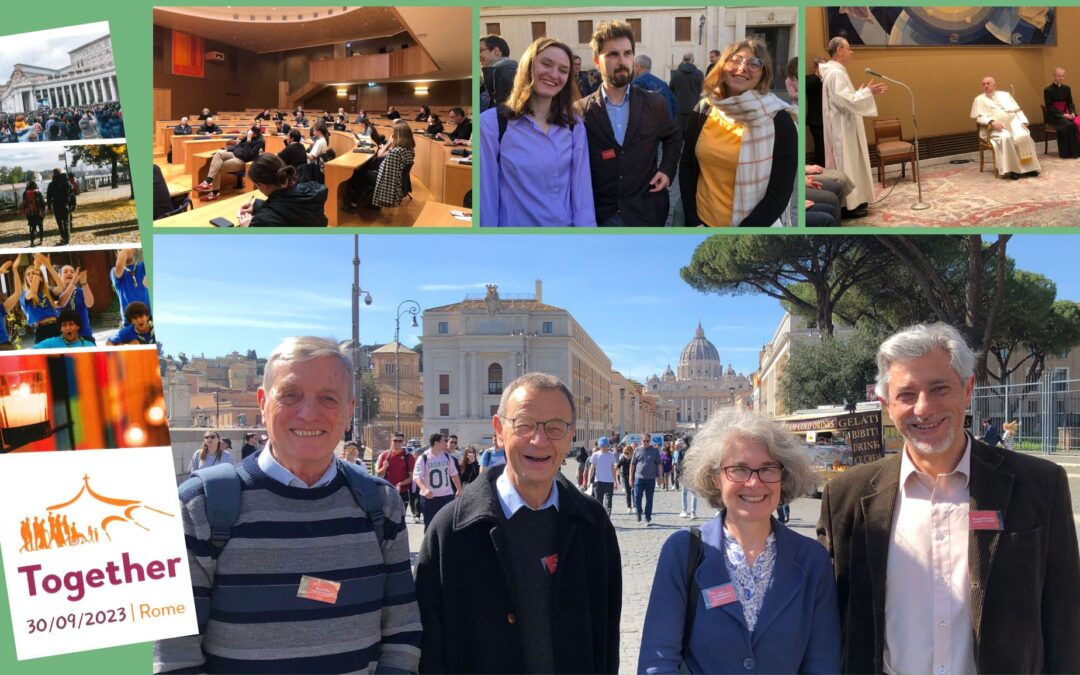
… but the sky is clear and the sun provides some warmth. It is very early: we walk toward the Vatican. We are a group of about 60 persons from various Churches, representatives of Episcopal Conferences, Congregations, Movements and Communities, young and not so young, laypersons, priests, consecrated religious, all of us following Brother Alois and some brothers from the Ecumenical Community of Taizé, with the presence of Sr. Nathalie Becquart, Under-Secretary of the Synod of Bishops. This is the third time this group has come together and for three days we have worked together, in plenaries and in 10 commissions, to prepare Together2023.
An original initiative
This is an original initiative, the only one of its kind so far, promoted by Taizé: to prayerfully support the Synod of the Roman Catholic Church on Synodality, whose first session is scheduled for 4-29 October 2023. All Christians, from every Church and Community are invited to this event, especially young people.
The event consists of a day – 30 September 2023 – filled with a wide variety of initiatives; the culmination will be an evening Prayer Vigil in St. Peter’s Square. Pope Francis and Church leaders are expected to attend. It is intended to be a plea from all God’s people for graces for the participants of the Synod, who will be dealing with the central theme of Synodality.
Pope Francis meets us
We quickly enter the Vatican via side entrances and soon find ourselves in a small room prepared especially for us. The Bishop of Rome was not long in coming; he was visibly pleased to meet our group and, in the absence of a text, improvised a few thoughts interwoven with personal memories. His esteem for Brother Alois and his courage is evident; his faith in walking together, which makes unity greater than differences, is great. It is about loving one another, working together as Christians, asking for the presence of the Holy Spirit: it is He who creates unity and harmony.
We leave this meeting with joy in our hearts and a commitment to walk together with many other Christians – in Rome on 30 September and everywhere else.
Info at: www.together2023.net
Diego Goller
Photo: Alice Montrucchio; large photo, from left: Diego Goller, Frère Alois Löser, Sr Nathalie Becquart, Giuseppe Del Coiro
by Diego Goller | 1 Apr 2020 | Experiences, reflections and interviews, News
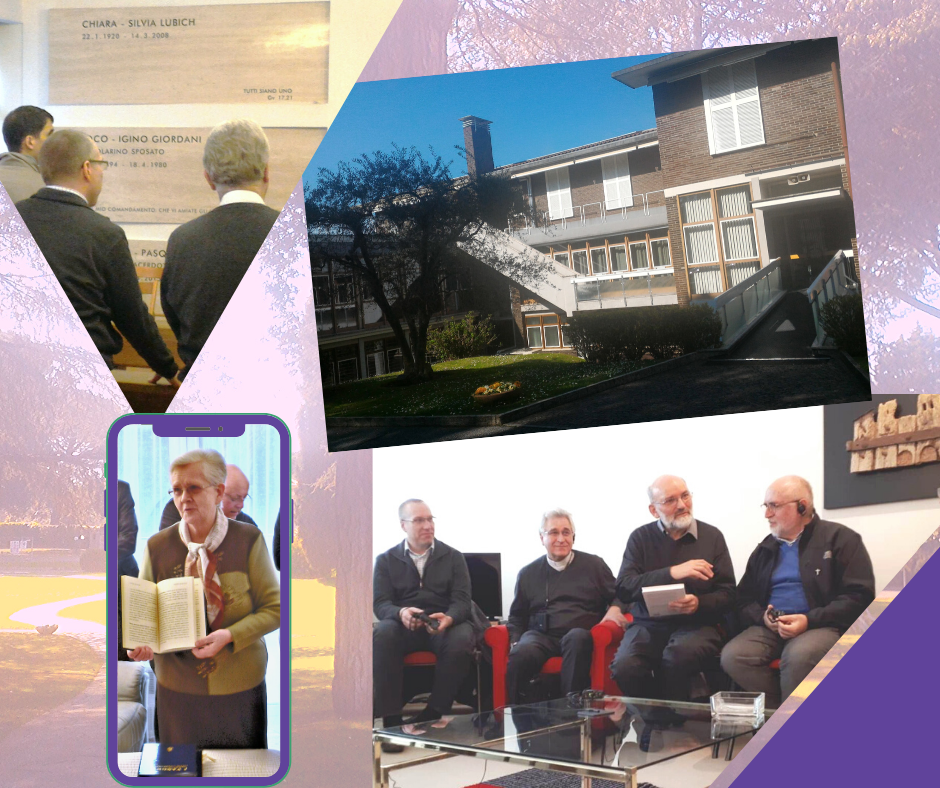
Some time ago, before the covid-19 emergency, leaders of the Schönstatt Movement coming from seven European Countries have visited the International Centre of the Focolare Movement in Rocca di Papa, near Rome. They came from Austria, the Czech Republic, Germany, Great Britain, Italy, Spain and Switzerland. The group was accompanied by Fr Heinrich Walter, a former president of the General Presidium of Schönstatt and a member of the Steering Committee of Together for Europe.
The main objective of the visit was to “encounter Chiara Lubich”: they visited the places where she had lived and they also prayed at her tomb. Another objective was to hold a dialogue with some leaders at the Focolare Centre; one of these was Jesús Morán, the Co-president. They discussed the role of the Movements and their charisms in a context of ecclesial, political and cultural transformations in Europe. They also looked at the importance of the communion between the Movements, especially as part of the ecumenical network Together for Europe.
Both groups shared the view that the meeting and the dialogue were cordial, precious and fruitful. Obviously, this was yet another step forward in the long journey of communion and collaboration that Schönstatt and the Focolare have shared since Pentecost Eve of 1998 in St Peter’s Square, Rome, during the meeting for New Movements and Communities organized by John Paul II.
Diego Goller