
by Jesus Moran | 25 Oct 2018 | 2016 Munich, Experiences, reflections and interviews, News
Here are excerpts from a speech by Jesús Morán Cepedano, co-president of the Focolare Movement, philosopher, specialized in theological anthropology, on the occasion of the Congress Together for Europe in Munich, June 30, 2016.
Why has Europe given rise in the last few centuries to a culture which has made God less of a mystery than an irresolvable problem? And, as a consequence, has made human beings into an inextricable problem in relation to themselves, to others, to creation and to the Absolute? This question is all the more “scandalous” if we think of the history of the European continent, which over many centuries developed a strong and original humanism in spiritual, artistic, philosophical, scientific, legal and political spheres.
In 2004, the then cardinal J. Ratzinger wondered if it was not true, as Arnold J. Toynbee states, that the destiny of societies largely depends on their creative minorities. Perhaps – he affirmed – this is the task that belongs to Christians: to conceive of themselves as the creative minority that leads Europe to rediscover its heritage.
We are reminded of the nature of this heritage in a masterly and surprising way also by intellectuals of the calibre of H G Gadamer and G Steiner, who while looking from very different contexts, perspectives and experiences, both see in Europe a task that is “as much spiritual as it is intellectual”. For Gadamer: ”To live with the other, to live as the other person’s other, is a universal task which is valid in the small and larger scales. Just as we grow and enter into life learn to live together with others, the same thing applies to larger groupings in humanity, to peoples and States’. It is probably a European privilege the fact of having had to and been able to learn to live with diversity.” (L’eredità dell’Europa, Einaudi, Torino 1991, pp.21-22)
This destiny calls for the creativity, ingenuity and capacity to get up again and go beyond its own limits that have always been part of the European soul, as has been shown by its entire history and above all after the Second World War. The founding Fathers of the European Project were able to grasp the moment and were bold enough not only to dream of another idea of Europe but to start making it happen by focusing on the integration of the entire heritage of the continent, being well aware, according to the prophetic words of Konrad Adenauer that: “The future of the West is not threatened as much by political tensions as by the danger of conformism, uniformity of thoughts and feelings; in a word, by the whole system of life, by flight from responsibility, with concern only for oneself.”[1]
It follows that the perspective that Europe can and must still, and more than ever, give to the world is that of forming a culture of unity in diversity at all levels, from the personal and daily levels to the institutional and forward-looking, as has been said recently by Patriarch Bartholomew, the Ecumenical Patriarch: “Even human institutions – if we are able to “transfigure them” with this focus on diversity – will understand that diversity is a gift and not a contradiction; it is wealth and not imbalance; it is life and not death. We live in a context in which pluralism risks being sacrificed in the name of a false unity, which wants the global levelling down of all expressions of human life. … Instead, with the acceptance of diversity as the foundation of the unity of a wounded humanity, through dialogue of love, through mutual respect, through acceptance of the “other” and our willingness to welcome and be welcomed, we can become for the world, icons of Christ and, like him, be in unity also in diversity.[2]
It is a question, therefore, of returning with new drive and urgency to evolve a culture of human rights which can wisely connect the personal dimension and that of the common good of all intermediate groups which unite in a social and political community. At the same time this should be done without losing sight of the transcendental dignity of every human being, as Pope Francis affirmed strongly in his 2014 talk to the European Parliament.
In following this path, the role of ecclesial communities is seen once again to be crucial and decisive because their task is precisely that of their mission, the joyful proclamation of the good news. We are at a time in which Christianity is being ex-culturated and the “cultural pact” between the Churches and society has been broken. In other words, it seems that the Christian cultural basis which formed the West has disappeared, through the emphasis on the principle of an autonomous society and its “exit from religion”. It is a question now of returning to the Gospel, to bring about significant encounters in the light of Scripture, the Gospel stories, so as to generate, indeed, the same life as Jesus generated. As Pope Francis emphasised just a few weeks ago, on the occasion of the conferral of the Charlemagne Prize: God desires to dwell in our midst, but he can only do so through men and women who, like the great evangelizers of this continent, have been touched by him and live for the Gospel, seeking nothing else. Only a Church rich in witnesses will be able to bring back the pure water of the Gospel to the roots of Europe. In this enterprise, the path of Christians towards full unity is a great sign of the times and a response to the Lord’s prayer “that they may all be one” (Jn 17:21).[3]
[1] Address to the Assembly of German Artisans, Düsseldorf, 27 April 1952. Quoted by Pope Francis’ in his address on the occasion of the Conferral of the Charlemagne Prize (6 May 2016).
[2] Lectio magistralis by Ecumenical Patriarch Bartholomew on the occasion of the Conferral of the Honorary Doctorate by the Sophia University Institute, Loppiano 26 October 2015.
[3] Pope Francis, Address on the occasion of the Conferral of the Charlemagne Prize, Rome, 6 May 2016.
Photo: ©Ursel Haaf – www.urselhaaf.de
by TogetherforEurope | 16 Oct 2018 | News
Little examples of synergy between Movements and “pro Europe” initiatives
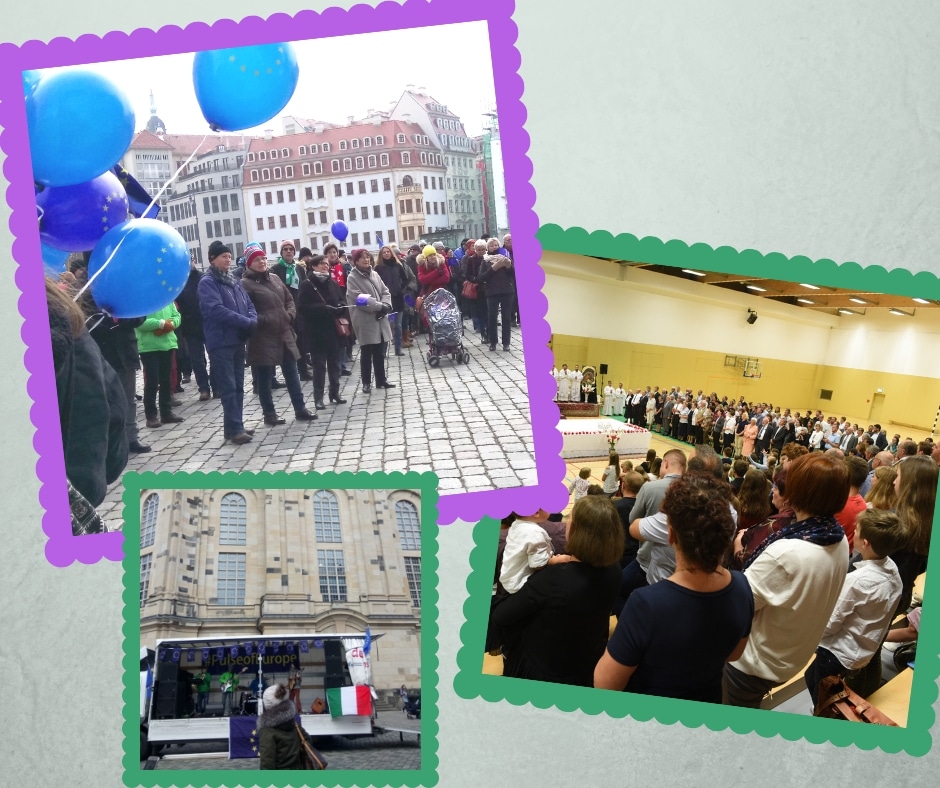
‘Together for’ in Dresden
We are a little group of the Focolare Movement in Dresden. A few months ago, in the city’s main square, we were able to speak to 200 people about universal fraternity, presenting the thoughts of Chiara Lubich that she had addressed to 700 mayors from Europe gathered together in Innsbruck in 2001. We were with other organisers including “Pulse of Europe”, an initiative which is open to all whose aim is to live together for a united democratic Europe. Each month this organisation puts together a programme to make people aware of their aims, emphasizing peace and all the values on which Europe is based. That ‘spiritual fraternity’ which also connects us through the person of Chiara who has spread the values of universal fraternity in people all over the world was very evident, also in view of the great project of building a united Europe.
One of those responsible for the young people of the dioceses, a Jesuit, hearing about our collaboration, strongly encouraged us: “Go ahead! You can make your contribution without complication. I really ask this for you: go ahead with courage, others are too afraid!” Yes, we are few but we must and can take the new path that He shows us! We are very happy to have known the people of “Pulse of Europe”, and they know that we support them. We can say this sincerely: their business, their great challenge is also ours.
Monika Scheidler, Ilse Fehr
The Neocatecumenal Way celebrates its 40th anniversary in Slovenia. It’s the opportunity to celebrate within the big family of the Movements.
On first of September, the Neocatecumenal Way in Slovenia celebrated the 40th anniversary of its presence in the country. Representatives from other movements, like Couples for Christ, Movimento Cammino (Pot), Focolare Movement, Renewal in the Holy Spirit and the Emmanuel Community celebrated with them. The celebration was really well prepared with a solemn mass, concelebrated with 5 bishops and at the end an agape which gave time and space for fraternal relationships and sharing. The visit for this anniversary of the first Neocatecumenal itinerants of Italy who had brought this spirit to Slovenia 40 years ago, was a particular gift. It was an opportunity to build real and deep relationships. We were welcomed very warmly in the hall and the present Movements were named as some of the special guests.
The network of different Movements in Slovenia has been strengthened over all these years also thanks to the reciprocal help and hospitality that, for example, the Focolare Movement has been able to offer in its Mariapolis Centre in Planina for 200 Ukrainians of the Neocatecumenal Way that travelling to Rome and back were able to stop and take rest there. With joy next week 80 Ukrainians will be hosted again on their way to the Eternal City. For those who are travelling towards Italy we are at a strategic point and we are also happy to offer the centre for sharing between the Movements.
Pavel and Marjana Snoj, Slovenia
Photos: private
by TogetherforEurope | 27 Sep 2018 | 2018 Friends | Prague, News
Together for Europe 2018 – Prague
Prague, capital of the Czech Republic, a country at the very heart of European culture and history, with pay host from 15th-17th November 2018 to the annual meeting of the Friends of Together for Europe.
The great history of Central Europe, in particular of the Czech nation will serve as a backdrop for a new stage in the journey of Together for Europe, which promotes dialogue between divergent cultural and political identities.
In November 2017 the European meeting of Friends of Together for Europe took place in Vienna, a bridge between Eastern and Western Europe. This year, we will have the opportunity to take another step to the very heart of Central Eastern Europe – Prague, with a singular desire to face challenges, prejudices and fears which weigh on the collective conscience of EU member states and beyond. Through the life of the Gospel, nourished and enlightened by the presence of Christ in the Christian communities, we wish to witness to the fact that the path towards Europe as a House of Nations and a Family of Peoples is not a utopia.
The enduring legacy of the “Velvet Revolution”
On 17th November, the Czech Republic commemorates the anniversary of the “Velvet Revolution” (so called due to its peaceful nature) which transformed the Czech Republic into a co-protagonist for the ongoing process of European reunification. The presence of the Friends of Together for Europe in Prague on this very day, urges us to renew our shared commitment: to bring to a post-secular culture the spirit of Christian Humanism, and in so doing contribute to building a more united Europe.
The renowned Czech Philosopher and Theologian Tomas Halik, friend of the late Vaclav Havel, Jaroslav Sebek of the Historical Czech Academy of Science, and Pavel Fischer an emerging Czech politician, together with leaders and representatives of different Movements, Communities and Associations will be present. Their contributions will reinforce the daring objective of this meeting: to recall a Europe of hope and promise, a Europe which stems from a rich heritage of ethnic, social and cultural diversity and calls out for communion and dialogue.
In this way, the Prague event will become a fundamental phase of Together for Europe which continues its commitment for a more united, brotherly and just Europe. It will also be a unique opportunity to prepare together for the upcoming elections for the European Parliament. The meeting will conclude with an open evening, in which Movements and Communities from different churches and which are present in the Czech Republic will be represented.
Address: Mariapolis Centre, Mladoboleslavská 667, 190 17 Prague 9 – Vinoř, Czech Republic – Tel. +420 286 007 711; Email: cmpraha@espol.cz; www.centrummariapoli.cz
Beatriz Lauenroth
Foto: Canva
by TogetherforEurope | 26 Sep 2018 | 2018 Friends | Prague, Experiences, reflections and interviews, News
Europe lives from the ideas it was born from.
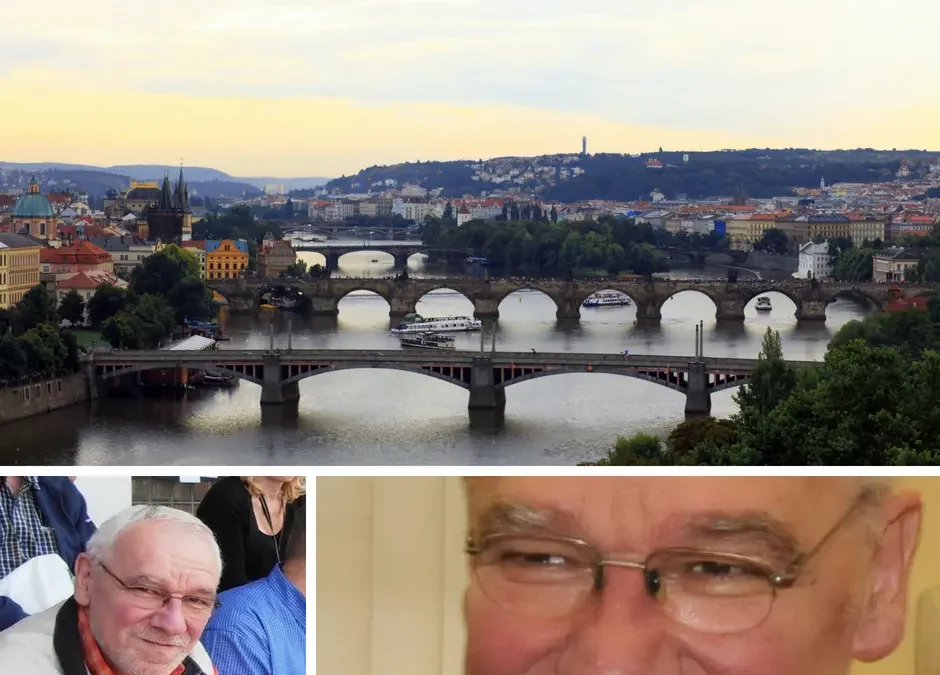
In preparation for the upcoming meeting of Friends of Together for Europe, we asked Jiři Kratochvil from Prague and expert in intercultural dialogue the following three questions.
The next appointment of Friends of Together for Europe will take place in Prague, the land of the ‘Hussites’, ‘Prague Spring’ and the ‘Velvet Revolution’. The great history of the Czech nation will become a backdrop to the ensuing dialogue at this meeting. How can we best approach this great history with an aim to understand it better?
It is a troubled history, characterised by great idealistic and spiritual awakenings, by a search for justice and truth which often ended with disappointment and disillusion. This applies to all three historical moments referenced in your question. Firstly, the Hussite movement born from the ashes of Jan Hus who was burned at the stake in 1415, and who was considered by his followers as a martyr for the Truth. Unfortunately, the ensuing wars which bore witness more to power than truth laid waste to the country. Several centuries later, in 1968, in a similar fashion, the main actors of the “Prague Spring”, with what seemed like the whole nation behind them, sought to establish a form of socialism with “a human face”. This new regime strove to shed the lies and cruelty of the previous era. Sadly, this new hope was dashed in the tracks left by the tanks and stagnated into a general collective resignation, which not even the heroically sacrificial gesture of Jan Palach, a student who burned himself alive in protest, was capable of ending.
Finally, the “Velvet Revolution” of 1989 which many of us remember clearly, was carried ahead by the slogan of its main protagonist Vaclav Havel “Love and Truth will overcome lies and hatred”. No one however expected the hard battle that followed. The spiritual values of the first months which were so strongly felt in the mass demonstrations in the squares slowly receded and were replaced by the pragmatism of the “technology of power”.
The flag of the president of the Czech Republic reads “Truth Prevails” however, two words have been left out from the original version of this quotation which was “Truth of God Prevails”. We are certain that His Truth will win at the end of History. However, before that happens, it must be dealt many blows as history, not only Czech history, shows. This does not relieve us of our obligation to always align ourselves to His side, the side of Truth.
“Together for Europe” wishes to contribute to building unity between Eastern and Western Europe, what role does the Czech Republic play in this commitment?
Due to its troubled history, the Czech Republic is a highly secularised country. The majority of the population do not identify with any Church. This does not mean all are atheists however, surprisingly the number of self-declared atheists has been diminishing. There is a strong sensitivity to spiritual and cultural values among young people and the intelligencia. This was demonstrated in 2009, by the warm welcome received by Pope Benedict XVI at the Accademia in Prague. It may have been that very welcome that inspired Benedict to establish the “The Court of the Gentiles”, an initiative aimed at dialogue with the laity.
Christians of different denominations united among themselves and engaging in such a dialogue in its various forms, show one of the ways of building the project of Together for Europe. Secular lay people in the Czech Republic are already leading the way in this dialogue.
Looking ahead, what further challenges await us in reaching our objective – unity?
An extremely difficult question, the answer to which, while not simple, seems logical. People say that every nation lives from the ideas it was born from. This can also hold true for a continent. Let us recall the roots of the Europe in which we all live. In Jerusalem (faith), Athens (reason) and Rome (law). On these strong foundations grew Europe’s cultural, spiritual and material greatness and wealth. Today we face situations of migrations of people similar to those of medieval times. The greatest challenge lies in knowing how to live with the diversity of the new arrivals, of which there will be many. Migratory currents will continue to flow not only for political and economic reasons but also due to the impacts of climate change.
Let us not delude ourselves: Europe as we know it, will sooner or later disappear, also due to decreasing birth rates. As Christians, we need to be that creative minority, returning to the solid foundations of our tradition and to the values it generated, whilst maintaining a sense of openness to new inspirations. Based on these spiritual foundations, asking continuously for the grace of God, we can seek a new unity for this new Europe.
Jiři Kratochvil, born in 1953. Degree in economics obtained in Prague. For many years worked in state owned bodies under the auspices of the Department of Finance. After the fall of communism, he was instrumental in the renewal of the Czech Caritas. He has lived in Canada, Italy, Germany, Czech Republic and Slovakia. Currently he lives in Prague and works as a translator for the Czech Episcopal Conference.
Photo: Prague: ©Canva; Jiři Kratochvil: private
by TogetherforEurope | 20 Sep 2018 | 2019 Europe Day, News
In 2019 Elections will be held for the European Parliament. Two weeks earlier, on May 9th, “Europe Day” will be celebrated. If we want to give our contribution to the establishment of a lively Europa with a promising future, we have to get started in time in the various countries and cities.
It seems that Together for Europe is more relevant than ever today, at a time when our continent is facing many challenges. We are convinced that God did not raise this network without a reason.
Europe is on everyone’s lips. But how will it be possible to make our contribution as Christians in the construction of today’s Europe? Our possibilities are limited. And yet it’s the small, but creative and motivated, minorities that can make a difference and contribute to change. For this reason it will be important that we leave our charisms to unfold: Our vocation of unity, our culture of “Togetherness” is today more necessary than ever.
9 May – Europe Day
At the meeting of the ‘Friends of Together for Europe’ in Vienna in 2017, the intent of Jeff Fountain (Netherlands) and of the Italian group, to make May 9th, Day of Europe, a lively event has given rise to much interest. This year, events have already taken place in some regions.
For 2019 it seems important to start including this date in our annual program, to gather locally as Movements and Communities and explore the possibilities of this day. It could also be useful to include other initiatives that are committed to a “Togetherness” in Europe. Two weeks later elections for the European Parliament will take place; there will certainly be favorable pressures and creative ideas. Therefore, in 2019 there is an added value: May 9th should be a day of joy, of celebration, of commitment and of prayer!
Europe needs our prayer.
In addition to the impulses and initiatives already launched , we see our contribution to Europe in prayer as well. After our initiatives in the wake of the 60th anniversary of the Treaties of Rome, on March 24, 2017, we saw its transforming force. We trust that much will move in heaven and on earth when we pray together in unity for our Continent.
Gerhard Proß, Diego Goller, P. Heinrich Walter
See also: Involve your city>
Foto: ©Ursel Haaf – www.urselhaaf.de
by TogetherforEurope | 22 Aug 2018 | 2016 Munich, Experiences, reflections and interviews, News
It´s a matter of growing ever more into a “culture of trust”, including a worldly trust in God.
Herbert Lauenroth’s presentation at the International Congress of “Together for Europe – Munich 2016″ is as current as ever. Here is the full text.
Dear friends,
I would like to start my – rather fundamental – reflections on the subject of fear, fear in Europe, with two striking biblical respectively secular images:
1 In a dramatic moment in the book of Genesis God calls man: “Where are you, Adam?” This call is addressed to the one who has sought refuge in the underbrush, full of shame and driven by fear. To the one hiding from the sight of God because he has become aware of his existential nakedness and wretchedness. This image depicts the present situation in Europe in a quite drastic way: A continent barricading and entrenching itself in its seemingly hopeless presence. Europe is hiding in the underbrush, stuck in the entanglements of its own limitations and a history of guilt. This underbrush is Idomeni, the Macedonian border, the barbed-wire fence at the Hungarian-Serbian border, but also the various exclusions in society.
If we read the biblical scenario as for turning Europe into a fortress, a measure against migrants, it allows another different reading: It´s the European sovereign standing before us, it´s his exposure and homelessness we`re looking at. He is the real refugee, trying to escape from himself, the most fatal of all flights. Therefore Europe has to hear this call from the Biblical God once again. It´s a question of its destiny, mission and responsibility for itself and the world: “Adam/Europe, where are you?”
2 This image of an existential narrowness God calls out of, finds its counterpart in the visions of men`s cosmic forsakenness in an indifferent, inhospitable universe. Philosopher and mathematician Blaise Pascal expressed it like this: “The eternal silence of these infinite spaces terrifies me!” It´s about a sense of being appalled or exposed that frightens man, as he is isolated and being thrown back on his own. In European history this recurring theme has been described as “loss of the center” or “transcendental homelessness”.
3 However, this fear of loss of self and the world can make room for new experiences at the same time: Czech poet and President Vaclav Havel, looking back on the peaceful revolutions in Eastern Central Europe in 1989/90, spoke of fear as “fear of freedom”: “We were like prisoners who had become accustomed to the prison, and then, being released to the long-desired freedom out of the blue, did not know how to deal with it and became desperate because they constantly had to decide on their own and take responsibility for their own life.” It is, according to Havel, to face this fear. This is how it “enables us to acquire new abilities: The fear of freedom can be exactly what teaches us to fulfil our freedom. And fear of the future can be exactly what forces us to do everything to make the future better.”
Finally, the great protestant theologian Paul Tillich takes fear for the basic experience of human existence: “The courage to be,” he writes, “is rooted in the God who appears when God has disappeared in the fear of doubt.” This means: only the experience of fear – as the loss of an image of God, man and the world that was formerly formative and considered to be immutable – unleashes what is called the “courage to be“. The true – divine – God appears so to speak in the heart of fear, and he alone causes de-frightening. In turn this experience leads man to deeper experiences and horizons of being. God reveals himself in the supposed facelessness and ahistoricity of the world as the face of the other.
4 It is therefore necessary to descend into these ‘inner rooms of the world’ of biographical as well as collective fears and experiences of loss, in order to meet the God who saves us. Two examples:
4.1 Yad Vashem: my visit to the Shoah memorial site last autumn is an unforgettable experience for me: I walk through the mazy-like architecture as if in a daze and finally reach the Children`s memorial, a subterranean space where the light of burning candles is reflected by mirrors. It`s a dark resonance space of bodiless voices, which unceasingly recall the elementary life-data of the innocent victims and I feel a new, deep solidarity – especially in view of this profound primal fear of not only being physically destroyed, but being even eliminated from the cultural memory. The testimony of this place becomes my own experience: to provide a place for the lost name, to preserve a memory for the name of God and its creatures. My guestbook entry is a sentence of the prophet Isaiah that expresses both my consternation and the new hope in the captive closeness of a fatherly God: “Fear not, for I have redeemed you. I called you by name, you are mine!” (Isaiah 43,1)
4.2 In view of the great European tales of fear, Czech philosopher and theologian Tomáš Halík describes a similar experience: “We do not build the bold project of European unity on unknown ground or wasteland. We build it on a ground, in whose layers forgotten treasures and burned debris are stored, where gods, heroes and criminals are buried, rusted thoughts and unexploded bombs. From time to time we have to set out on looking into the depths of Europe, into the underworld, like Orpheus to Eurydice, or the dead Christ to Abraham and the fathers of the Old Testament.”
5 For me, these various “descents into the depths of fear” converge in the description of the baptism of Jesus in the Gospel of Matthew: “As soon as Jesus was baptized, he went up out of the water. At that moment, heaven was opened, and he saw the Spirit of God descending like a dove and lighting on him. And a voice from heaven, said, ‘This is my Son, whom I love; with him I am well pleased.’“ (Matthew 3:16–17)
We have to descend with Christ to reach that point of origin, above which the sky opens up quite surprisingly. It´s where God’s law of life shows itself: “What comes from above must grow from below.” In this way, in, with and through Jesus, the “fraternal” community of solidarity is formed, in which the individual members do not only recognize themselves as “sisters and brothers” but also as “sons and daughters of God”, in which “dignity of man” and “God-likeness” form an indivisible unity.
6 In his book “Letters and Papers from Prison” (Widerstand und Ergebung) Dietrich Bonhoeffer describes the core of the Christian identity as a response to the question of Jesus at the moment of his mortal fear in Gethsemane: “Could you not watch with me one hour?” (Matthew 26,40) – It is an invitation to the night watch at the side of Jesus, in his presence facing the Father, in a secular – supposedly godless – world. This presence of Jesus transforms different locations into places of experience and expectation of Trinitarian life.
7 In this key section of the Gospel of Matthew “fear” appears as a privileged place of learning for our faith where diffuse, “blind” fears converge and transform into the authentic “fear of God” of Jesus that offers new insights.
As:
- In, with, and through Jesus, de-frightening takes place as a real frightening-through of man towards God: The supposed exposure of the Son changes to devotion to the Father.
- Unity grows as an experience of mutual trust. It grows from sensitivity for the mystery of God which is not at our disposal, the otherness (alterity) of the other. French-Jewish philosopher Simone Weil expresses this experience in a striking way: It´s only the unconditional “consent to the distance of the other” that allows for authentic closeness and communion with God and man.
- So that´s what it is about: Preferring the unknown, the unfamiliar, the marginalized – as a “learning place” of faith – in, with, and through Jesus.
- This especially applies to the different charisms and their communion: in Paris in November 2013 at a meeting of Together for Europe with Jean Vanier, founder of “L’Arche”, it became apparent to us: one of the real aims of the charisms is also to receive the “charism of the world” and to reflect it to this world. Vanier’s testimony has been very impressive: primarly it´s not about living with and for the “addressees” of the Beatitudes of Jesus, but from In fact they – the supposedly needy and receiving ones – are the God-gifted and giving ones. They are the bearers of a message, a presence of God that has to return to the center of our societies from their margins. Klaus Hemmerle, Bishop of Aachen and religious philosopher wrote concisely: “Let me learn from you the message that I have to pass to you”.
8 This attitude, however, requires a “thrust reversal”, a true metánoia of many a Christian on their understanding of themselves and the world. It calls for a new faith in God’s love for the world which is revealed in Christ. It´s a matter of growing ever more into a “culture of trust”, including a worldly trust in God that is founded in Jesus.
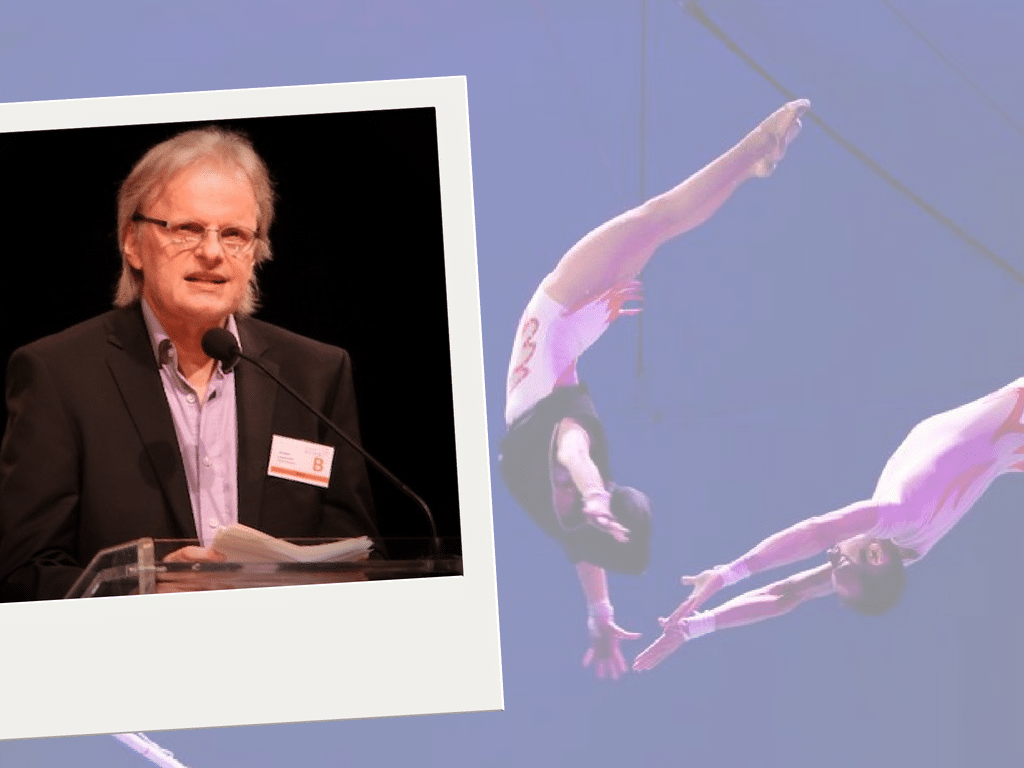
9 Looking up into the dome of the Circus-Krone building, we might think of some trapeze artists. For me, they are the true artists of de-frightening: Flyers hovering in the air, always taking the risk of trust, letting go and stretching out again for future spaces. An artistic moment in that prophetic and always fragile, risky intermediate state of “grace and gravity”: The grace of weightlessness, yet the creature always having a knowledge of being held and secure, in a certain sense “redeemed” from itself and liberated for turning towards the other.
With this in mind, Henri Nouwen writes: “A flyer must fly, and a catcher must catch, and the flyer must trust, with outstretched arms and open hands that his catcher will be there for him. […] Remember that you are the beloved child of God. He will be there when you make your long jump. Don’t try to grab him; he will grab you. Just stretch out your arms and hands – and trust, trust, trust! “
Herbert Lauenroth, Ecumenical Center Ottmaring (Germany), in Munich, Circus-Krone-Bau, 01/07/2016
Photo: trapeze artists ©Thierry Bissat (MfG); H. Lauenroth: ©Ursula Haaf