
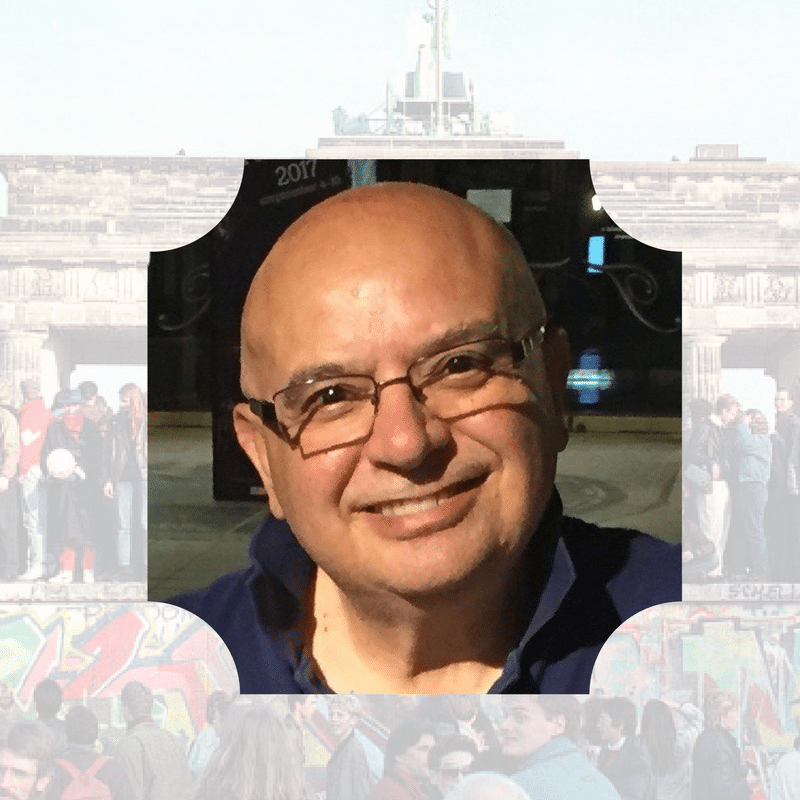
‘Behind the iron curtain’ was a metaphorical attribution given to those countries that from the end of the Second World War until 1989 were part of the communist bloc. The ‘iron’ curtain in question represented the ideological split which divided Europe in two halves, an ideological split physically represented by the Berlin Wall.
When for research purposes I visited Prague, in former Czechoslovakia, the memory of Jan Palach was very much alive with many university students considering him a hero: on 16th January 1969 Jan Palach set himself on fire to draw the attention of the world to the exasperation in which his nation lived. My impression was that in the capital city of Czechoslovakia two parallel worlds coexisted: one official and visible, and another hidden but ever so present.
I had a similar experience living in Hungary in the 1980s. At that time, only a censored and sanitized version of news from Eastern European countries reached the West… Not much was known about Hungary outside the events of 1956. Initially I travelled to Budapest on a research scholarship into children’s literature, but my stay developed into a chain of surprising events and considering the political and historical context – small miracles.
Thanks to the translations I became known for, I received an award which allowed me to remain in Hungary as a lecturer at the Janus Pannonius University of Pecs. In a context of politics manipulated by interests and ideology, the ability to incorporate any kind of positive message into teaching required a sense of personal responsibility and freedom.
On one of my train journeys, while waiting at one of the endless border custom checks, I spotted a bird jumping on the barbed wire fence dividing the two countries. This sight prompted me to ponder how long those barriers would remain and I drew some hope from Giambattista Vico, a philosopher from Naples, Italy, who spoke about the fact that things which are outside their natural order do not remain so.[1]
In 1989, immediately after the fall of the Berlin Wall I happened to conduct a sociological study on the change of toponyms of the streets and squares of Budapest and on destiny of statues left in that country by communist realism. These were eventually to be transferred to a specially designated garden which served as a sort of a ‘historical ZOO’ where parents would bring their children on Sundays… Some of the Soviet red star sculptures would have to wait for years to be taken down owing of their sheer size and weight.
After 16 years in Hungary, and after visiting other former Warsaw pact countries such as Slovakia or Poland, and places such as Auschwitz I understood better the reason of my being and I have become more and more grateful to God for the possibility to help make Europe and the entire world a family.
I also feel how right Victor Hugo was in in his famous [mis]quote : “Nothing is more powerful than an idea whose time has come”.[2]
by Tanino Minuta
[1] Giambattista Vico, Opere Vol. I, Tipografia della Sibilla, Naples, 1834, p. 12. [free translation]
[2] http://nuovoeutile.it/222-frammenti-sulla-creativita-a-cura-di-annamaria-testa/ [http://www.quotecounterquote.com/2011/02/nothing-is-more-powerful-than-idea.html]
0 Comments