
When Together for Europe was launched on 31st October 1999 on the day the Joint Declaration on the Doctrine of Justification was signed there was a real sense of hope in the air.
It was an important sign of unity after almost 500 years of division. Various spiritual communities and movements from Protestant Churches and the Catholic Church met in the Ecumenical Life Centre in Ottmaring to consider how this fundamental declaration could be received. This declaration had to become more than mere words. It had to have an impact on everyday life. Karl Barth once spoke of Christians carrying a Bible in one hand and a newspaper in the other.
Over the centuries since the reformation of Martin Luther and other reformers, serious conflicts have arisen from the divisions and disputes between Christians rendering them unable to fully accomplish their mission as instruments of unity and peace. These splits were a sad sign of weakness in the face of dramatic events which reached crisis levels in the 20th century with the outbreak of two world wars and the abyss of the holocaust.
Nevertheless, Christians were still credible witnesses. When John Paul II announced a Great Jubilee for the Year 2000 he spoke of how today’s Church had again become a church of martyrs and more than ever before. According to the Polish Pope who had experienced the oppression of the Church in his own life, this had become an ecumenical phenomenon. Not only because it affects Christian of all traditions but also because the Christians persecuted in the gulags and concentration camps have already had an experience of unity in suffering which needs to be built on. Andrea Riccardi gives a moving account of this story in his book “Salz der Erde, Licht der Welt”.
The historic signing of the Joint Declaration marked the start of a new story of unity and collaboration. In response to so much division and violence that had originated in Europe the movements wanted to help to build a Europe which works for peace, hospitality and openness. Globalisation has brought about unity in economics, money and communications, yet the soul is missing, the unity of peoples and cultures living together peacefully and openly is missing. This is where the movements recognise their vocation, a second vocation to that of their own charism.
We have experienced various episodes in the story of Together for Europe which is now approached its 20th anniversary. There was the euphoria following the introduction of a single European currency and extension of the European Union to former Eastern bloc countries in 2004 which was tangible at the first major congress in Stuttgart. The movements wanted to strengthen and support the process of European unification since, according to the Christian ideals of the founding fathers of European unification which celebrated the 60th anniversary of the Treaty of Rome in 2017, this process needs spiritual foundations. Europe needs a soul as we continue to emphasise.
There is increasing scepticism regarding Europe. There is the alarming tendency towards isolation, walls are being built and Europe is becoming a fortress which ostracises people and turns them away. Much of European society is in the grip of widespread fear which is also affecting Christians. This dangerous fear has led to a rise in pro-exclusion nationalism, xenophobia and antisemitism and the birth of extreme right-wing and fascist movements which are having an increasing influence on European politics.
So the question of our vocation for togetherness needs to be addressed with greater urgency than before. As conflicts increase, Christians and Christian movements need to deepen their togetherness. Our way has always been marked by hospitality and openness. Unity is only possible by being open with, getting to know and welcoming one another. Audacious and prophetic Christians are needed precisely in this phase of history since the current trends in European society today are dangerous and promote violence. And it is the poor, refugees, foreigners and all those who live on the edges of society who suffer.
Europe Day on the 9th May gives us a unique opportunity to highlight the beauty and enrichment of unity. We can show how diversity, openness, hospitality and welcoming the stranger, rather than being a threat, actually represent an enrichment for everyone. Diverse movements were born from the Gospel, each with their own stories, vocations and charism and no-one is taking anything away from them. Quite the contrary. Through meeting one other we have enriched one other and deepened our own charism. This experience is needed more today than 18 years ago in Ottmaring when we started our journey together.
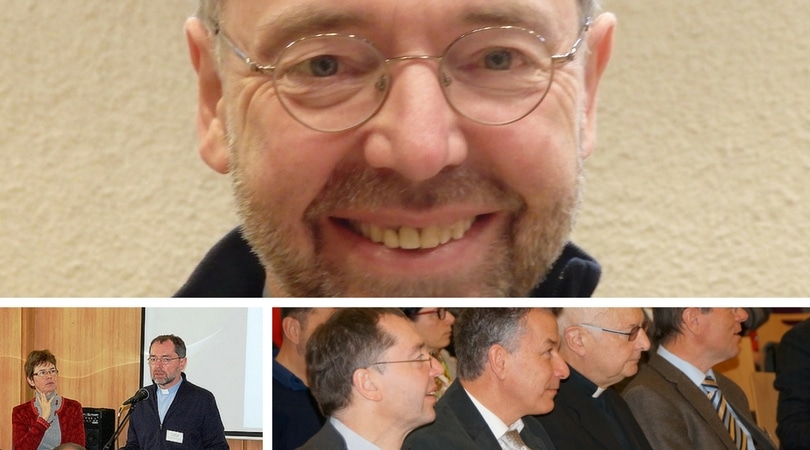
Matthias Leineweber, catholic pastor
0 Comments