
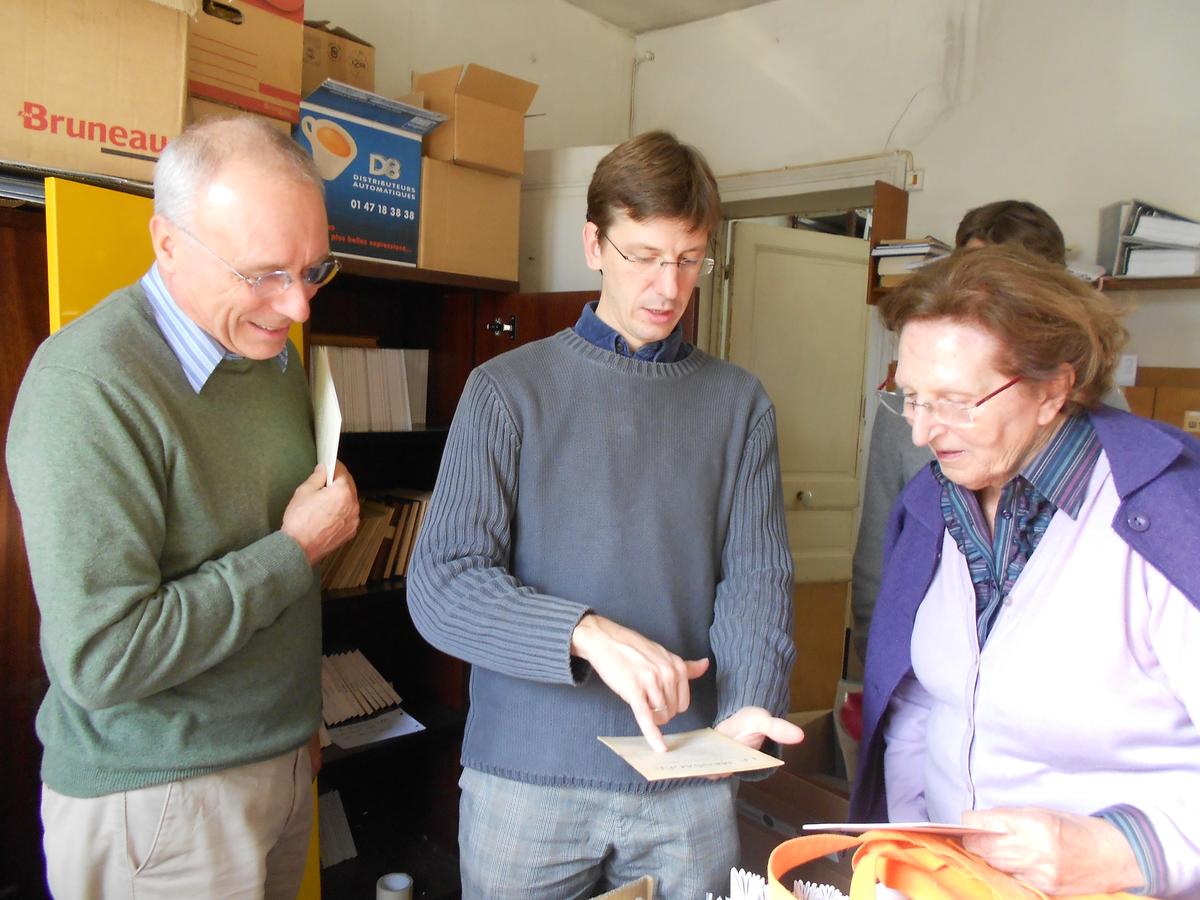
During the annual meeting of the “Friends of Together for Europe” in Paris, on 6th November 2013 representatives of the Focolare Movement visited the headquarters of the Orthodox Movement, Acer-Mjo.
Spiritual trust, depth of sharing, discovery of a real friendship in Christ as a seed of a Christian European conscience; these are just a few of the fruits of the visit of representatives of the Focolare Movement to the headquarters of the Acer-MJO Movement (Russian Students’ Christian Action – Orthodox Youth Movement) in Paris. During the annual meeting of “Friends of Together for Europe” which took place on 7th-9th November in the French capital, Gabri Fallacara, Severin Schmid and Maria Wienken from Focolare, were received by Cyrille Sollogoub, President of the Orthodox association.
The Acer Movement was started in 1923 by some Russians who had been expelled from their country during the troubled years of the Revolution. The founders include such important personalities as Fr. Sergio Boulgakov, Fr. Giorgio Florovsky and Nicolas Berdiaev. The President, accompanied by his brother Igor who is responsible for the youth section, took us to the Church – Chapel , housed in a former garage in the courtyard, covered with glass. The Divine Liturgy has been celebrated here by famous Orthodox priests and theologians like Florovsky , Bulgakov and Alexander Men. Cyrille explained that “The icon that best expresses the charism of the Acer Movement is the presentation of Mary in the Temple: she contains Jesus and therefore she contains the Church. While in Russia, the churches were being destroyed and the Russian emigrants did not have the means to build others, a new understanding of what the Church is was born: not built from bricks but by living people, bearers of Christ and of his Church.” The aim of raising awareness, especially among the laity, of “being Church” is therefore at the origin of the Acer Movement which was approved by the Patriarch of Russia, Tikon, who was then assassinated; it depends juridically on the Patriarch of Constantinople.
The President recalled, “During the regime one of the main tasks of Acer was to print the Bible, spiritual and cultural literature and get it to Russia. It also supported thefamilies of dissidents and others in need.” Printing is still an important activity for Acer. The youth section is very active and involves over 200 young people. Despite the challenge of distance, summer camps are organized for them in the mountains, as an opportunity for re-evangelization; in this way the sense of faith and of belonging to the Church grows. Once trained, the young people get involved in their own parishes. This beautiful opportunity to meet and get to know one another left us with a sense of gratitude to God who brings us together in the world today with eyes of hope, open to a future of communion.
Gabri Fallacara
0 Comments