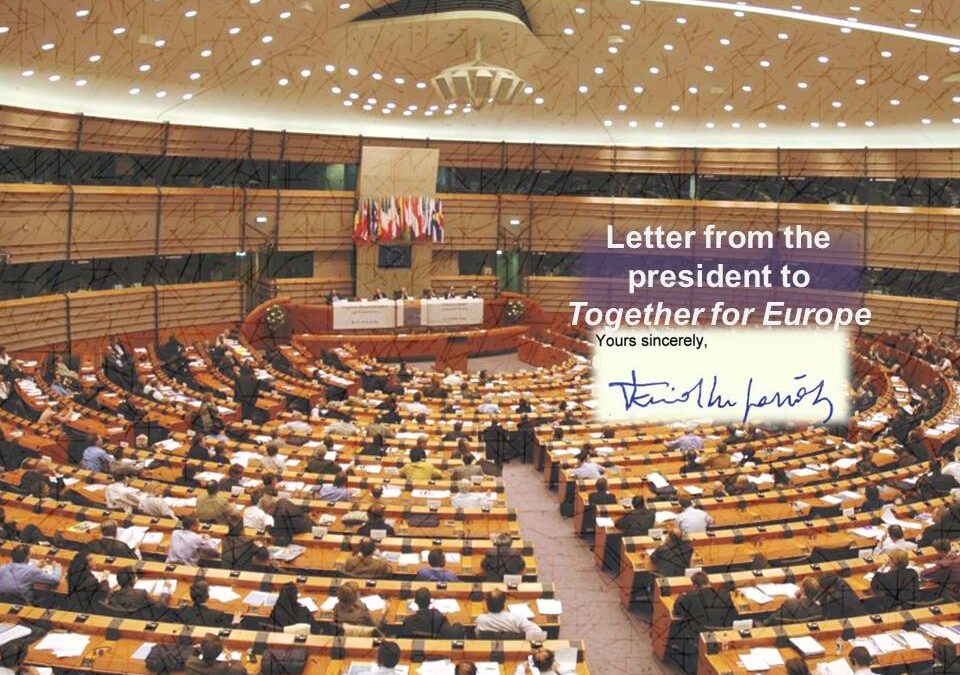
Together for Europe has received a letter from David Maria Sassoli, the president of the European Parliament. He emphasized the great need of the common European values to tackle crises. He also added that he would be delighted to keep in contact with our network.
In a letter addressed to Together for Europe (TfE), David Maria Sassoli, the president of the European Parliament, expressed his gratitude to the ecumenical network for its service toward the European Continent. Mr Sassoli observed that even Europe’s Founding Fathers were fully aware that the political project EUROPE could function properly only if nurtured also with a lived-out spirituality. He affirmed that: “European shared values, as agreed upon by Member States when signing the EU Treaties, are more needed than ever to overcome crises, including the current COVID-19 pandemic”.
Fighting selfish egoistic and nationalistic temptations
The president underlined how much he appreciates all the initiatives that “stimulate public discussions on civic matters”. In the European Parliament’s aims and in the commitment of the network Together for Europe, he sees “a shared approach based on solidarity and idealism”. Indeed, the COVID-19 crisis, the need for more ecology and the way the European Union deals with third-county nationals arriving on its territory “are all issues that cannot be tackled without fighting selfish and nationalistic temptations”.
Encouragement for future steps
The ecumenical network considers this letter of appreciation to be an encouragement for future steps. The letter from Brussels shows that prayer and action for Europe, like the initiatives linked to May 9, are an important contribution toward its unity.
We have been journeying together for the last six weeks. During this shared prayerful journey we allowed the Word of God and our reflection regarding Europe (2016) to inspire us, and we included all European Countries in our prayers. Our main objective was to strengthen our yearning to be all one and to mould Europe with the power of prayer.
May 9, Europe Day
Our journey will take us toward May 9, 2020, Europe Day. This Day ought to be a day of encounters between Communities, Movements and Countries. This year, however, due to Covid-19, we cannot gather physically in churches and squares, or hold social events, conferences and prayers.
This does not mean that the Day’s activities have been cancelled; on the contrary: a lot of creativity is being expressed in digital conferences and prayers, discussion groups and on-line dialogue between Communities, Movements and politicians that will be start, for example, from Utrecht, Graz, Rome, Lyon and Esslingen. Here all linguistic and National barriers will be overcome and thus we can reflect together about Europe and to keep the Continent in our prayers.
Letter from Pope Francis
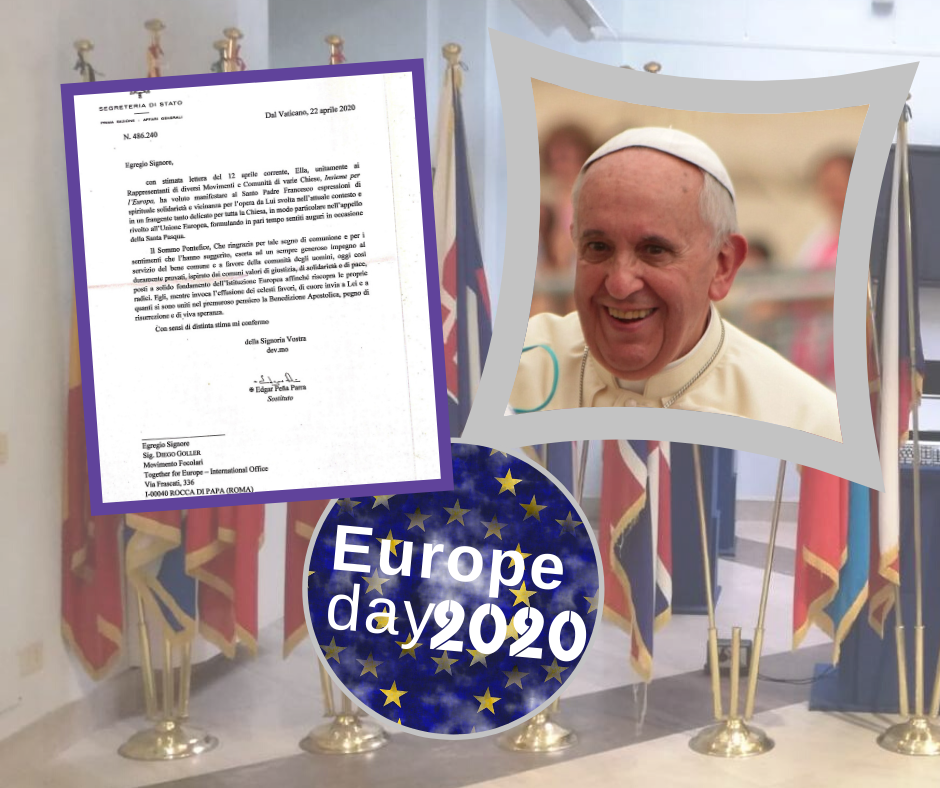
All our events linked to May 9 have a papal blessing. Indeed, Pope Francis, on 22 April, sent a letter to the Secretariat of Together for Europe in Rome in which, after thanking us for our letter of April 12, he encouraged in the service to the common good, inspired by values of solidarity, peace and justice. He pray for us and he warmly sents his apostolic blessing to all of us.
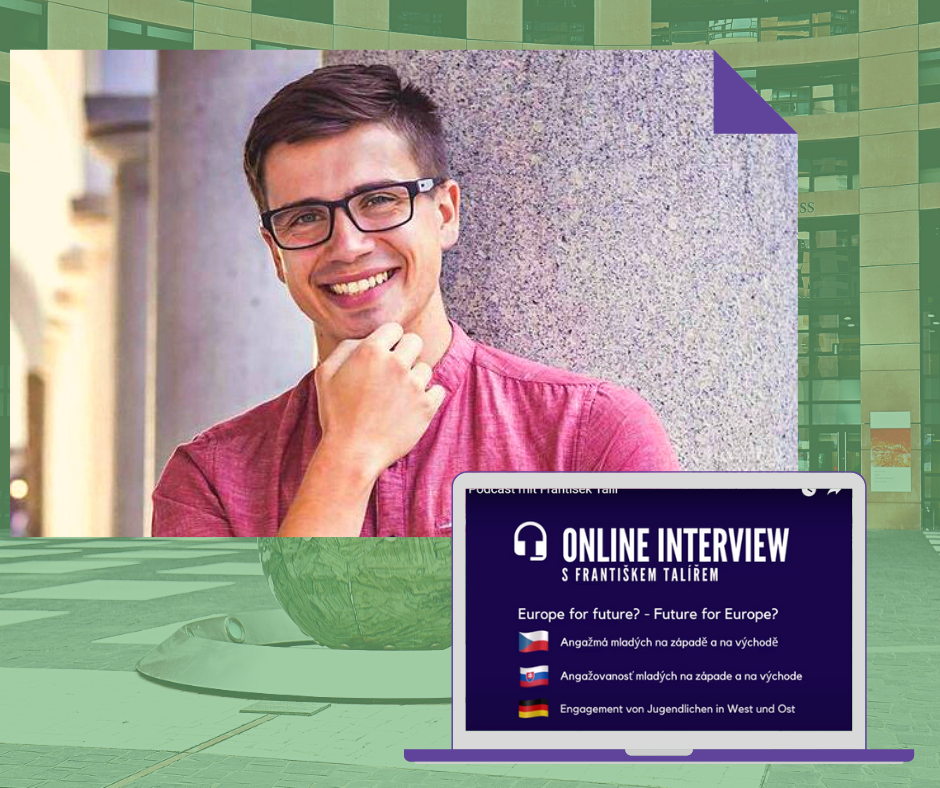
Europe for the future – Future for Europe. František Talíř is 27; when he speaks about democracy and reforms, his enthusiasm is contagious.
“Since 1989, we have experienced the freshness of democracy and freedom even in the Czech Republic and Slovakia. Joining the EU as well as travelling and working in other Countries bear witness to this. It must be borne in mind, nevertheless, that the Countries that used to form part of the Eastern Block have a different mentality and culture than that of the Western European ones. Co-habitation is still marked by tensions, and, now, Covid-19 has shown that our privileges are not that evident”.
František is a historian and much involved in politics. At the last elections, his party chose him as a candidate for the European Parliament in Brussels, and in the next regional elections he will be the main candidate for the Christian Democratic Union of Slovakia.
“Above all, we young people ought to be interested in what happens in Europe and in the world, and then take initiatives, for example, to vote or to be active in a political party. It’s not democracy that needs to be changed, but the persons who shape democracy”. According to František, the journey is a long one; however, what is important is to start with one’s self, and not try unloading one’s responsibility on others. “I do not subscribe to all that Fridays for Future entails. Nevertheless, the young people succeeded to highlight a problem and to elicit a reaction from persons of all generations”.
František Talíř invites all persons to be aware of their roots in order to give a future to Europe. “I’ve read what the Father Founders of Europe wrote. Adenauer, De Gasperi and Schuman faced by far greater difficulties following the Second World War than the ones we are facing today. And yet, together, they did great things”.
Beatriz Lauenroth
František Talíř took part in the meeting of ‘Friends ofTogether for Europe’ that was held in Prague in 2018.
The entire interview of František Talíř with Maria Motykova is available (In Czech, Slovak and German) on: Podcast Europa per il futuro – Futuro per l’Europa
Letters from Together for Europe to the E.U. and the Vatican
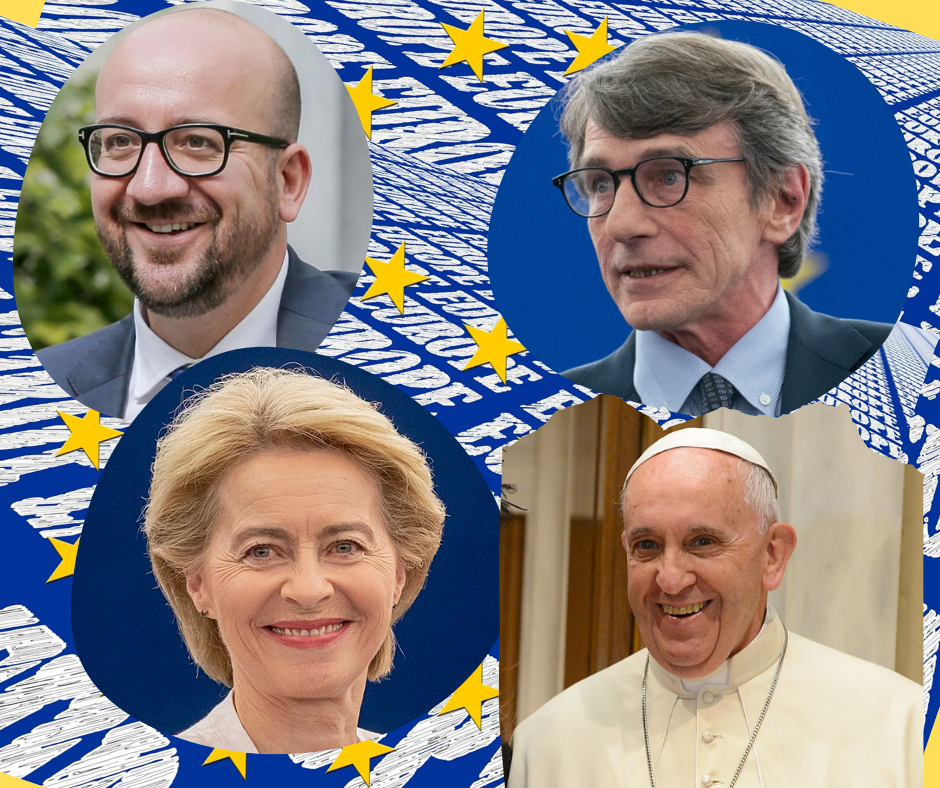
It is a crucial moment for Europe and the European Union, requiring concerted action. For this reason Together for Europe has written to the Presidents of the European Parliament, the European Commission and the European Council (David Sassoli, Ursula von der Leyen and Charles Michel) to thank them for their work, and to support them in their decisions in the fight against Covid-19.
To quote from the letter: “… at this time, we want to work and pray for the whole of Europe and for solidarity in Europe. We are convinced that Europe’s future – and that of the world – has be worked out together. Even now Europe can lead by example. And in the midst of the enormous challenges posed by the Covid-19 pandemic, we ask you not to forget the refugees and asylum seekers at the borders of the European Union. Please take timely measures to help and – as far as possible – welcome those people.”
Another letter has been sent to Pope Francis. On Easter Sunday, he specifically invited the world to face the pandemic together. The Steering Committee of Together for Europe assured the Holy Father of their support and commitment. “In particular, we feel challenged by your special appeal to the European Union to find a positive way forward in this epochal challenge, knowing full well that «not only its future, but that of the whole world could depend on it». Furthermore, “We firmly support your call and renew our commitment in many parts of Europe to give further proof of solidarity also by resorting to alternative solutions.”
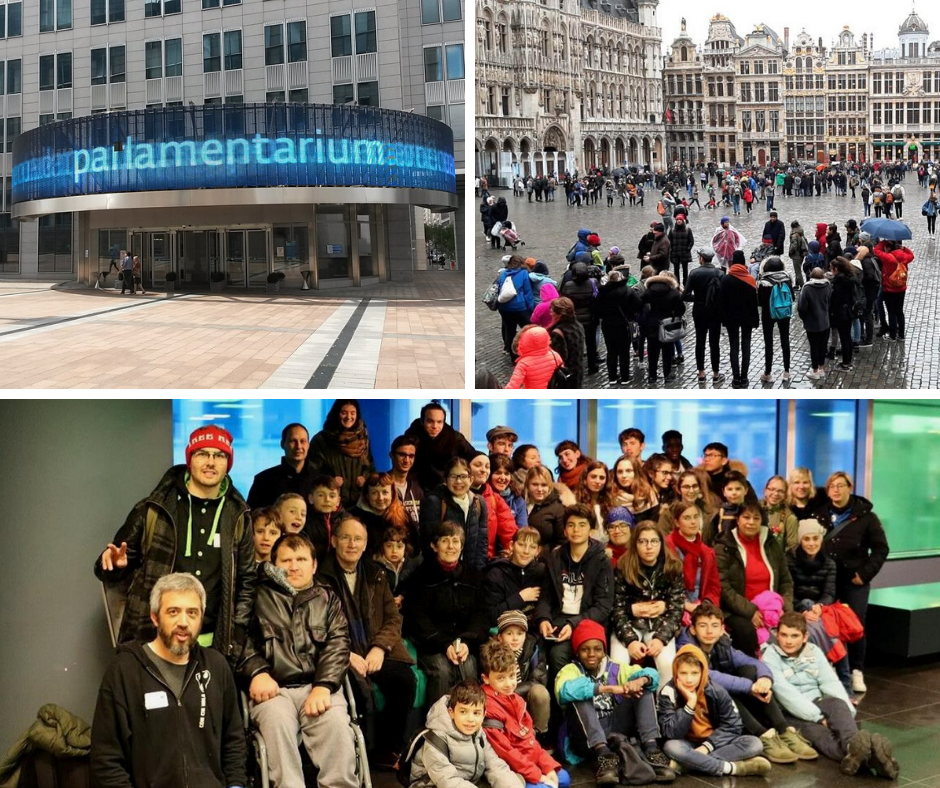
23 February 2020: Intergenerational Day in Brussels. 51 European citizens – young and old – members of two diverse Communities, which are part of the network Together for Europe, share a “discovery tour” of significant places.
Agnès Grenier writes from Brussels:
“During the Ottmaring meeting that marked the 20th anniversary of Together for Europe, I came to know Pierpaolo of the Pope John XXIII Community. Pierpaolo has recently asked me to help organize a guided visit to our city for a group of 51 young and older persons from all Europe. Philippe and I, members of the Focolare Movement, immediately accepted to act as guides. In spite of the rainy and cold weather, we did our best to help our new friends discover some aspects of the European realities present in the Belgian Capital City.
For example, in the Parlamentarium we could follow the various stages of the integration of Europe; we also saw how the European Parliament functions and understood better the work that the MEPs carry out to face today’s challenges. We were all struck by the complexity of this structure and we understood how great and fundamental the intuition of the Founding Father of the European Union was to build new relationships of collaboration and trust between the various European Nations.
We then visited the Grande Place/Grote Markt, the historical City centre of Brussels. For many centuries it was the venue of political meetings, court sittings, cultural and religious festival, and even where capital punishments were carried out.
At the end of the day we felt enriched with so much history. Above all, however, we felt that the bonds that link the Focolare Movement and the Pope John XXIII Community have been strengthened: we felt as if we were one family. Together, we have enlivened a small expression of the European Union!”
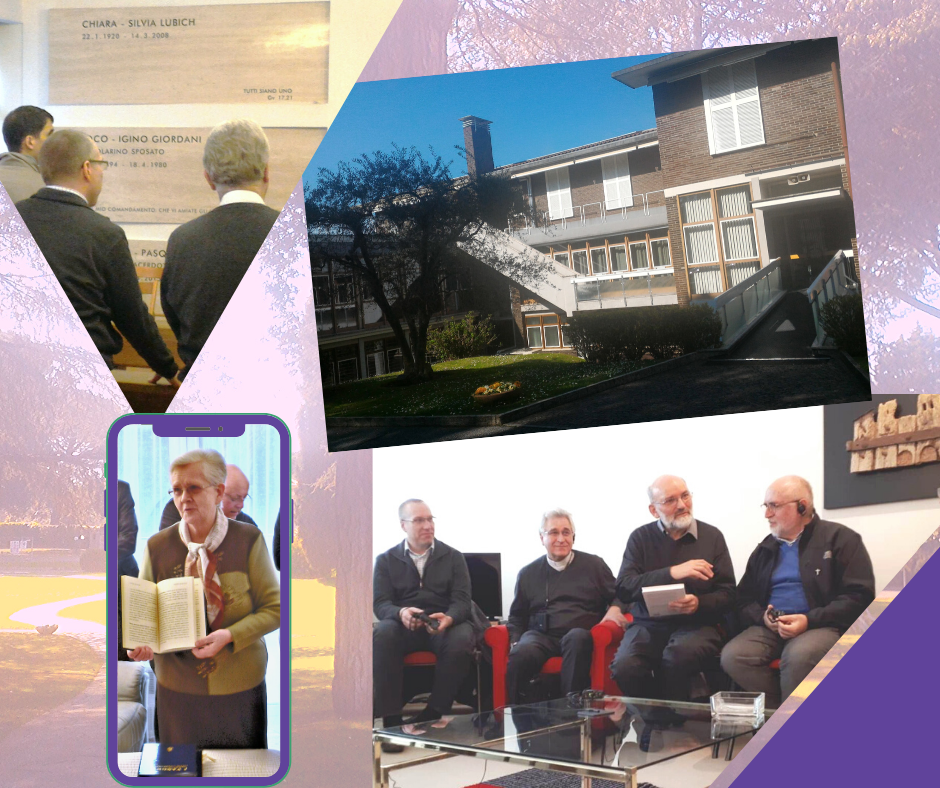
Some time ago, before the covid-19 emergency, leaders of the Schönstatt Movement coming from seven European Countries have visited the International Centre of the Focolare Movement in Rocca di Papa, near Rome. They came from Austria, the Czech Republic, Germany, Great Britain, Italy, Spain and Switzerland. The group was accompanied by Fr Heinrich Walter, a former president of the General Presidium of Schönstatt and a member of the Steering Committee of Together for Europe.
The main objective of the visit was to “encounter Chiara Lubich”: they visited the places where she had lived and they also prayed at her tomb. Another objective was to hold a dialogue with some leaders at the Focolare Centre; one of these was Jesús Morán, the Co-president. They discussed the role of the Movements and their charisms in a context of ecclesial, political and cultural transformations in Europe. They also looked at the importance of the communion between the Movements, especially as part of the ecumenical network Together for Europe.
Both groups shared the view that the meeting and the dialogue were cordial, precious and fruitful. Obviously, this was yet another step forward in the long journey of communion and collaboration that Schönstatt and the Focolare have shared since Pentecost Eve of 1998 in St Peter’s Square, Rome, during the meeting for New Movements and Communities organized by John Paul II.