
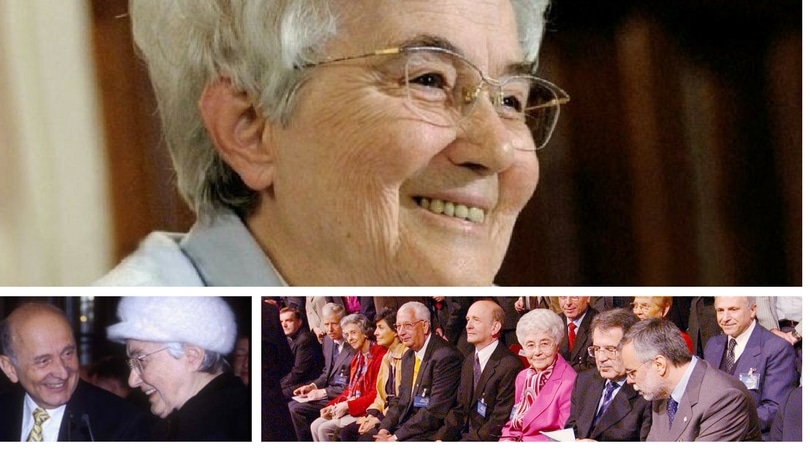
Chiara Lubich, one of the initiators of Together for Europe, spoke several times about the communion between the Movements and Communities of various Churches. An excerpt from a talk she gave to the leaders of Catholic and Evangelical Movements in Munich, on 8th December, 2001, can inspire us.
“The first thing we can ask ourselves is: are the Movements, of the kind we now see present in the main Churches, inventions devised by the Holy Spirit only for this age? Oh no! – we would have to answer – they have always existed, at various times, ever since Christianity was born. Just take a look at our common history of the first millennium, and we already see them appear. What is the reason? We know it. Christianity is present in the world because of faith and the Word lived. And we know how the early Christians lived our religion authentically. But we are also aware of how, over the years, because of the influence of the spirit of the world, not all the baptized have been coherent to the faith and so Christianity languished and became watered down. But since it cannot be extinguished, “the forces of hell will not prevail” (Mt. 16:18), there was a need, so to speak, for the Holy Spirit to give rise to new spiritual currents in the Church, including some very important ones, like those of Basil, Augustine, Benedict, etc. Then there were many others during the second millennium, like that of Francis of Assisi, who had precisely the task of bringing back the authenticity and radicalism of the Gospel to the Church, so renewing it. And it is for this same reason that the Holy Spirit has aroused, today too, our modern Movements. (…) Among many movements an ever deeper community has developed.
And what did we do? We began to live communion in this way. First: by praying for one another; then by encouraging each other, helping each other in difficulties; by making sure that the respective Councils got to know one another; by giving concrete help when others needed something, for example meeting rooms or equipment; by participating and collaborating in each other’s activities; by giving space for presentations of other Movements in our publications, etc. (…)
But here arises a question: how can we make our own this wonderful plan of God, which despite our weaknesses and our failures, foresees a vibrant and ever wider communion in the Church,? It is evident – to create communion everywhere, it would be enough to put into practice the new commandment of Jesus. (…)
“Who can separate us from the love of Christ who has bound us together in this way?” It will be because of this life of communion of ours, which bears witness to the world, that the name of God will come back into fashion in our streets, often frozen by materialism and secularism; in our homes, in our schools, in workplaces, in local government. We already bear witness, especially on the most advanced frontiers, the places where, in general, the Church cannot arrive by normal means, but where our Movements are often present. In fact, the Holy Spirit has called us to this and has therefore made us particularly fit for it. (…)
Because that something which should distinguish us, before the world, is not so much our prayer or other wonderful things like penance, ceremonies, fasts, vigils, moral conduct, etc., what should distinguish us is only our mutual love, unity. Jesus said: “By this will all men know that you are my disciples: if you love one another” (Jn. 13:35). By this and not by anything else, and he also said: “May they be one so that the world will believe” (Jn. 17.21). “
0 Comments