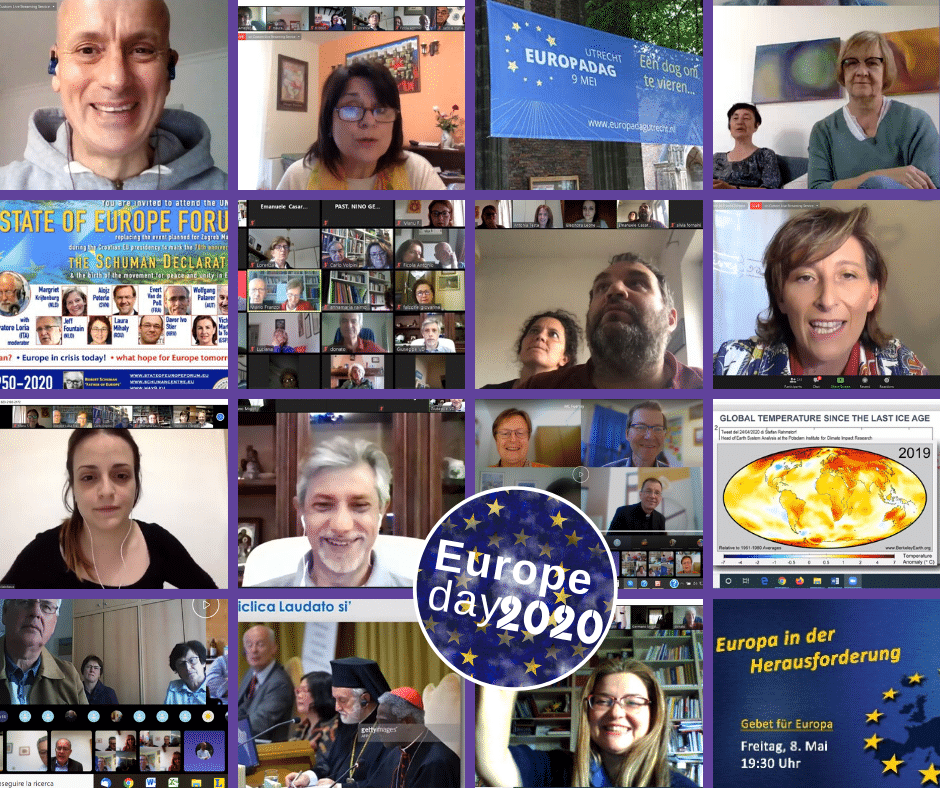
Living May 9, 2020, online: Due to Covid-19, all the events planned for the Europe Day, which involved Together for Europe were held online. Together for Europe was in contact with persons from all over the Continent through discussions, conferences, prayers and singing.
Italy
In Italy, more than 900 Friends of Together from all over the Country joined in a Zoom conference. The theme was: “Integral ecology: a sustainable utopia for Europe”; two keynote speeches dealt with how to work for the planet’s better present and an even better future by respecting nature and persons. The meeting was concluded with an ecumenical prayer with representatives of numerous Churches and Communities, and with the renewal of the ‘pact’ of mutual love.
The Netherlands
Two conferences, one based in Utrecht and another in Amsterdam, were held in The Netherlands. “Utrecht in Dialogue” and “Pax” provided small online groups with food for thought during their lively discussions regarding ideas about Europe. Many young people took part.
The ‘Schuman Centre’ discussed the present situation of the Continent. 70 years ago, Robert Schuman announced his plan to start laying the foundations for a European Home embracing 500 million inhabitants. Jeff Fountain, the founder of the ‘Schuman Centre’, which was established ten years ago, concluded the discussion with an unusual form of prayer. He sang in English on the tune of “Ode of joy”,the Europahymnus, a rewritten interpretation: “With the vision now before us of a true community / Of all European peoples, rich in our diversiy / Let us pray and work together for our solidarity / Peace, equality and freedom, rooted in your charity.”
Austria and Eastern Europe
The City of Graz was linked to six Countries for an exchange of lived out experiences. The Friends of Together in Austria, Slovenia, Croatia, Slovakia, Hungary and Northern Italy shared how they were living the Covid-19 crisis in the spirit of mutual support. At the end, Bishop Wilhelm Krautwaschl thanked the participants for their witnessing as an international community, and concluded saying: “In spite of our differences and separations, through the cross we are all united one to the other”.
Germany
The YMCA of Esslingen-Stuttgart thought that at the planned prayer meeting, only locals would participate. However, when they moved the event online, the Friends of Together were linked to other Movements in diverse German, Italian and Dutch cities. Indeed, for all of them the evening turned out to be a true experience of Togetherness.
France
In France there were 34 link-ups scattered in Paris, Lyon, Strasbourg, Toulouse and Tours that formed a national network that manifested the diversities between the groups, and, at the same time, a profound mutual esteem. Gérard Testard (Efesia) encouraged the participants to make the ‘French voice’ ever more present in Europe. One of the participants concluded: “It was a moment of fraternity and trust in Europe that filled us all with a new hope”.
Beatriz Lauenroth
The events will be available online in the next few days on:
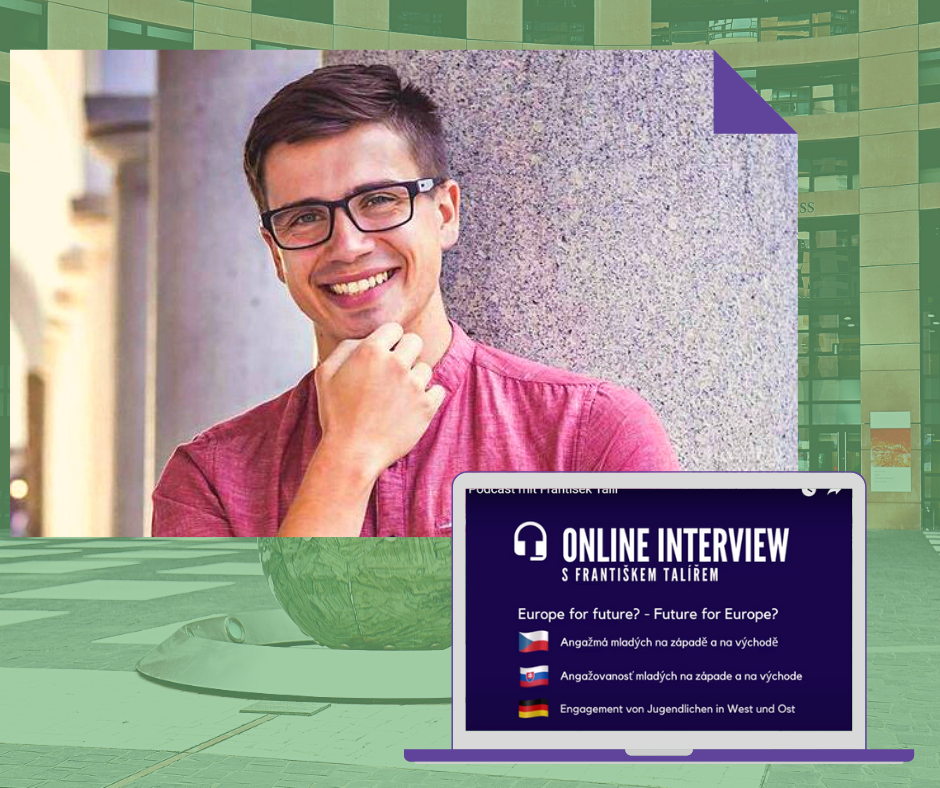
Europe for the future – Future for Europe. František Talíř is 27; when he speaks about democracy and reforms, his enthusiasm is contagious.
“Since 1989, we have experienced the freshness of democracy and freedom even in the Czech Republic and Slovakia. Joining the EU as well as travelling and working in other Countries bear witness to this. It must be borne in mind, nevertheless, that the Countries that used to form part of the Eastern Block have a different mentality and culture than that of the Western European ones. Co-habitation is still marked by tensions, and, now, Covid-19 has shown that our privileges are not that evident”.
František is a historian and much involved in politics. At the last elections, his party chose him as a candidate for the European Parliament in Brussels, and in the next regional elections he will be the main candidate for the Christian Democratic Union of Slovakia.
“Above all, we young people ought to be interested in what happens in Europe and in the world, and then take initiatives, for example, to vote or to be active in a political party. It’s not democracy that needs to be changed, but the persons who shape democracy”. According to František, the journey is a long one; however, what is important is to start with one’s self, and not try unloading one’s responsibility on others. “I do not subscribe to all that Fridays for Future entails. Nevertheless, the young people succeeded to highlight a problem and to elicit a reaction from persons of all generations”.
František Talíř invites all persons to be aware of their roots in order to give a future to Europe. “I’ve read what the Father Founders of Europe wrote. Adenauer, De Gasperi and Schuman faced by far greater difficulties following the Second World War than the ones we are facing today. And yet, together, they did great things”.
Beatriz Lauenroth
František Talíř took part in the meeting of ‘Friends ofTogether for Europe’ that was held in Prague in 2018.
The entire interview of František Talíř with Maria Motykova is available (In Czech, Slovak and German) on: Podcast Europa per il futuro – Futuro per l’Europa
On the 9th of May we will celebrate Europe Day and through this online dialogue we will discuss the EU project: after 75 years of peace within the EU, how do we move forward?
you will receive an email with the link and the password that will allow you to participate. Participation is free of charge.
Languages: Dutch and English
It’s been 70 years since the Schuman Declaration and we have enjoyed 75 years of peace in Europe. What about the future?
The European Union, which embraces 513 million inhabitants and a great diversity of Countries, cultures and identities, is a unique project in the history of humanity. It is the greatest peace project that followed the Second World War. Robert Schuman once said: “The European co-operation and integration could not, and must not, be limited to an economic and technical endeavour: it needs a soul, an awareness of its historical roots and its present and future responsibility, together with a political will to serve the common human ideal”. Thirty years ago, in 1989, we witnessed the fall of the Berlin Wall: it was a promising event, one that took us all, Easterners and Westerners, by surprise. A wave of euphoria swept over all Europe: peace in Europe, peace for all!
In 2020, 70 years since the Schuman Declaration, we will discuss the development of this human project and, above all, how to keep on making it better. We will speak about culture and values in Europe: how do we deal with our differences and what do we have in common? Which are our historical roots? What kind of future do we desire for Europe? Which are the main challenges that Europe must face? How can we work together to promote a stable peace in Europe, and which values are indispensible for this objective? We will try to answer these questions during our small groups’ discussions.
Program
2.00 p.m. Interactive introduction of the theme
2.15 p.m. Video by PAX: ‘Four future scenarios for Europe in 2040’
2.20 p.m. Dialogue at the ‘tables’ (parallel session with groups’ discussion)
3:20 p.m. Plenary session to gather feedback from the dialogue sessions
Together for Europe in the Netherlands actively supports this initiative, organized by Pax voor vrede en Comité Europadag Utrecht. Hope to see you!
Letters from Together for Europe to the E.U. and the Vatican
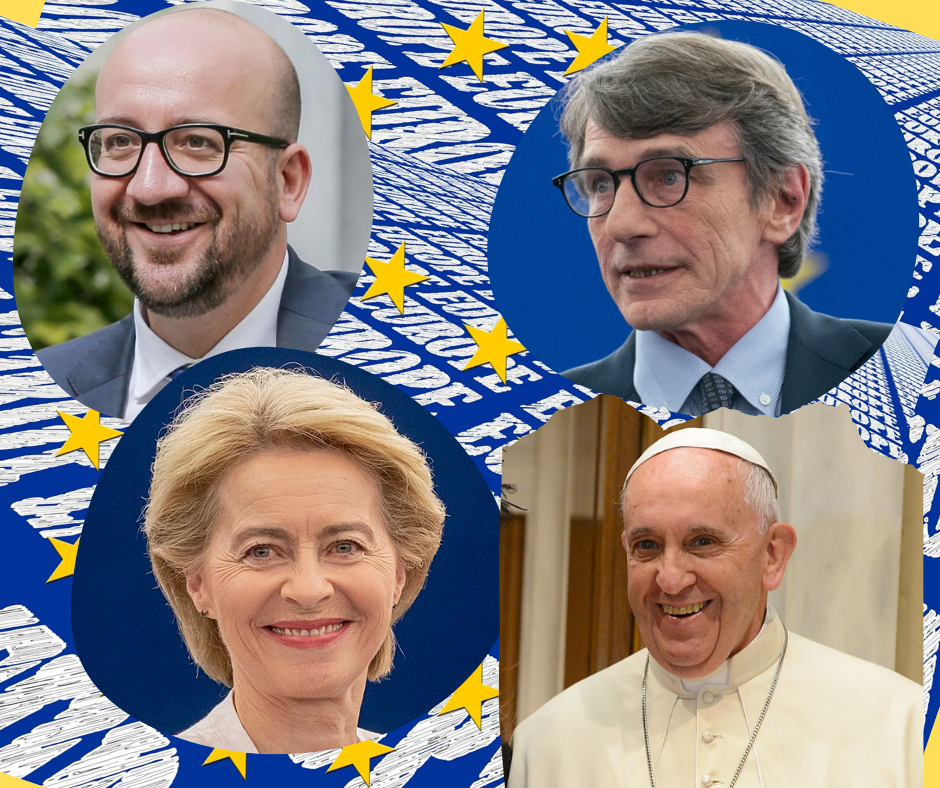
It is a crucial moment for Europe and the European Union, requiring concerted action. For this reason Together for Europe has written to the Presidents of the European Parliament, the European Commission and the European Council (David Sassoli, Ursula von der Leyen and Charles Michel) to thank them for their work, and to support them in their decisions in the fight against Covid-19.
To quote from the letter: “… at this time, we want to work and pray for the whole of Europe and for solidarity in Europe. We are convinced that Europe’s future – and that of the world – has be worked out together. Even now Europe can lead by example. And in the midst of the enormous challenges posed by the Covid-19 pandemic, we ask you not to forget the refugees and asylum seekers at the borders of the European Union. Please take timely measures to help and – as far as possible – welcome those people.”
Another letter has been sent to Pope Francis. On Easter Sunday, he specifically invited the world to face the pandemic together. The Steering Committee of Together for Europe assured the Holy Father of their support and commitment. “In particular, we feel challenged by your special appeal to the European Union to find a positive way forward in this epochal challenge, knowing full well that «not only its future, but that of the whole world could depend on it». Furthermore, “We firmly support your call and renew our commitment in many parts of Europe to give further proof of solidarity also by resorting to alternative solutions.”
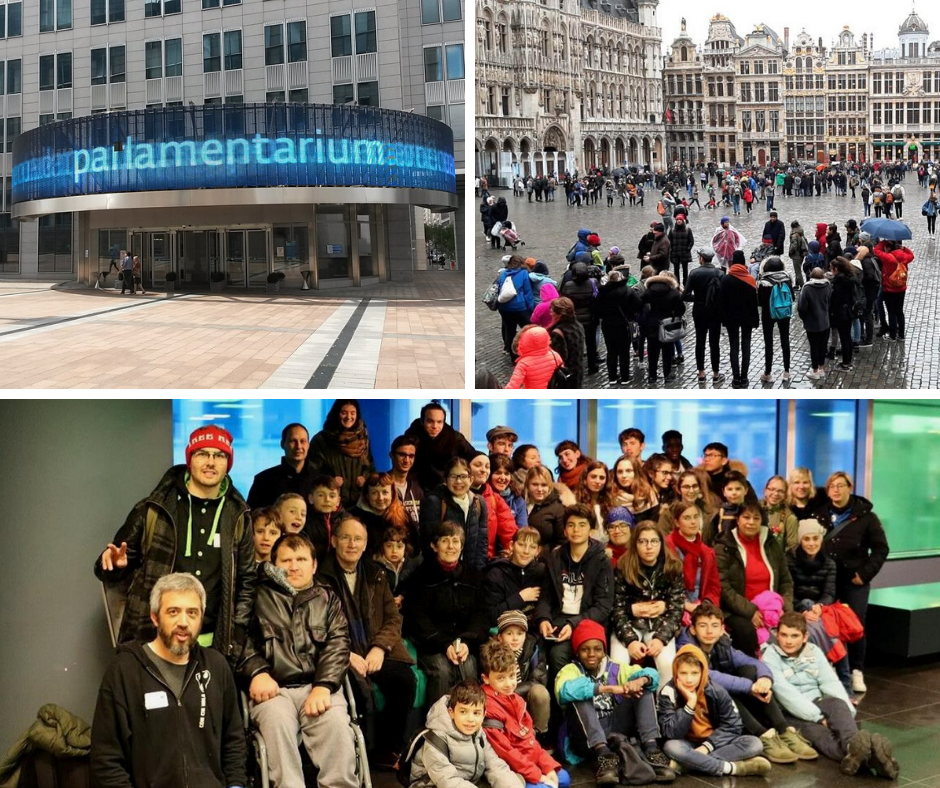
23 February 2020: Intergenerational Day in Brussels. 51 European citizens – young and old – members of two diverse Communities, which are part of the network Together for Europe, share a “discovery tour” of significant places.
Agnès Grenier writes from Brussels:
“During the Ottmaring meeting that marked the 20th anniversary of Together for Europe, I came to know Pierpaolo of the Pope John XXIII Community. Pierpaolo has recently asked me to help organize a guided visit to our city for a group of 51 young and older persons from all Europe. Philippe and I, members of the Focolare Movement, immediately accepted to act as guides. In spite of the rainy and cold weather, we did our best to help our new friends discover some aspects of the European realities present in the Belgian Capital City.
For example, in the Parlamentarium we could follow the various stages of the integration of Europe; we also saw how the European Parliament functions and understood better the work that the MEPs carry out to face today’s challenges. We were all struck by the complexity of this structure and we understood how great and fundamental the intuition of the Founding Father of the European Union was to build new relationships of collaboration and trust between the various European Nations.
We then visited the Grande Place/Grote Markt, the historical City centre of Brussels. For many centuries it was the venue of political meetings, court sittings, cultural and religious festival, and even where capital punishments were carried out.
At the end of the day we felt enriched with so much history. Above all, however, we felt that the bonds that link the Focolare Movement and the Pope John XXIII Community have been strengthened: we felt as if we were one family. Together, we have enlivened a small expression of the European Union!”