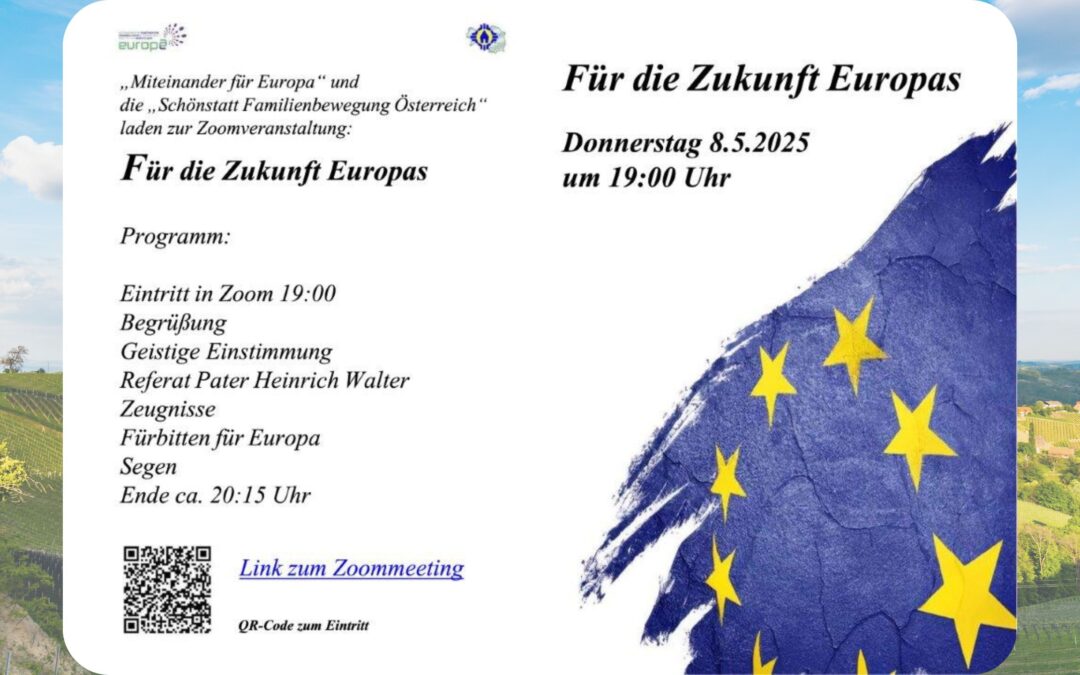
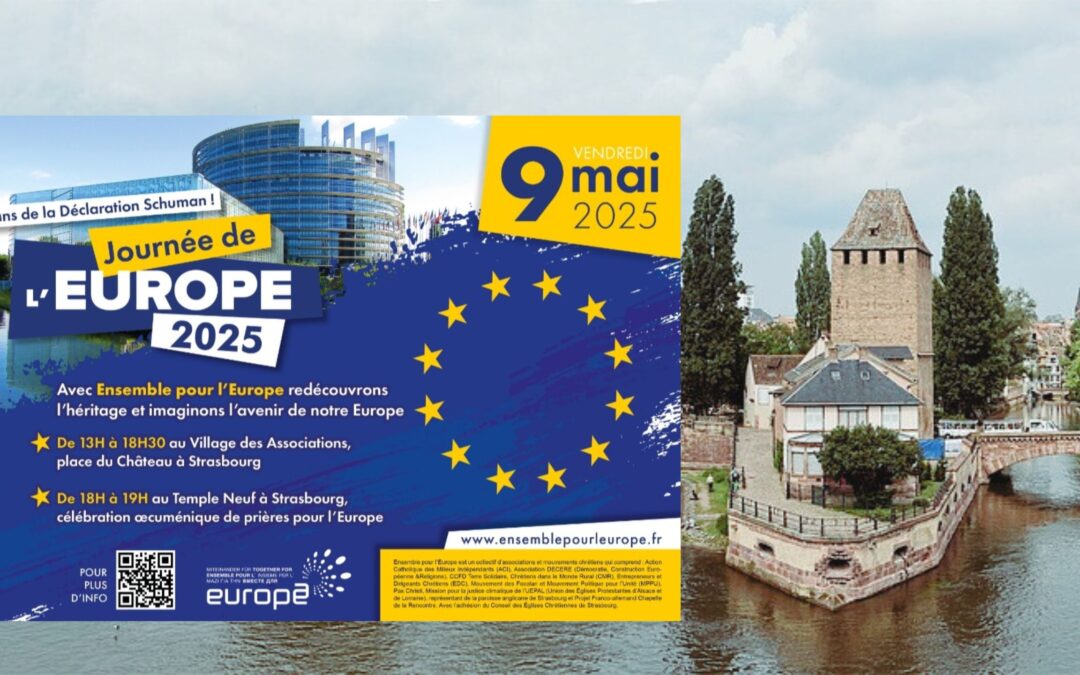
Seventy-five years after the Schuman Declaration, the European Parliament will host a special event on 15 May entitled ‘A Soul for 21st Century Europe’, promoted by the ecumenical network Together for Europe (TfE). The initiative aims to rediscover the spiritual dimension and the value of peace that animated the founding fathers of the Union, offering insights into contemporary challenges.
Following a musical opening and a welcome by MEP Miriam Lexmann and TfE moderator Gerhard Pross, there will be a speech by Jeff Fountain (Schumancenter, Netherlands) on the deep meaning of the Schuman Declaration.
A key moment will be a discussion between MEPs from different political groups, including Miriam Lexmann, Leoluca Orlando, Antonella Sberna and a French MEP, to reflect on the relevance of Schuman’s legacy.
The second part of the event will feature young people, with an international panel discussion and political testimonies, including that of European MP Cristina Guarda. Personalities from the ecclesial and political world, such as Father Manuel Barrios Prieto, Metropolitan Nikitas Ioan Vulpesku of the Romanian Parliament, former Slovakian Prime Minister Eduard Heger and Prof. Alberto Lo Presti will contribute to the discussions.
This will surely be an opportunity to imagine the future of Europe in the light of its founding values, as we promote memory, dialogue and hope.
In the afternoon, there will be a prayer meeting in the Chapel for Europe with the aim of reflecting on political responsibility and reconciliation in Europe. The programme includes Bible readings, prayers of thanksgiving, asking for forgiveness and intercessions for Europe, peace and for politicians. The ceremony will end with the ‘Prayer and Covenant Pact for Europe’ and a final blessing. Music and multi-lingual songs will enrich the meeting.
Moderator: Federico Castiglioni, researcher at the Institute of International Affairs
First part: MEMORY
Speakers
Dr. Carmine Maraio, student of International Relations
Dr. Maria Pia Di Nonno, expert in European history
Second part: OUR CURRENT TIMES
Speakers
Riccardo Cristiano, journalist and Vatican observer for the Italian National TV station
Giulia Covalea, Ambassador for the Fondazione A. Megalizzi
Third part: PROPHECY
Speakers
Dr. Angèle Mulibinge Kaj, student of International Relations
Prof. Alberto Lo Presti, University lecturer at Lumsa University (Rome)
Immediately afterwards (scheduled time 18.45) an Ecumenical Prayer Vigil for Europe will take place in the Basilica of Santa Maria in Aracoeli, with the participation of numerous representatives of the Christian Churches present in Rome.
At the conclusion, there will be a “convivial and friendship” moment in a hall adjacent to the Basilica.
For about four years now, before the outbreak of the large-scale war in Ukraine, we have been meeting online every Thursday evening to pray together for peace; we are from different cultures and nations in Eastern and Western Europe. And for the past few months, representatives from the Holy Land have also joined in.
There are only a hundred of us, but it is always a sacred moment that makes us feel like one family praying and asking God for peace together. For us here in Ukraine it is a great gift to pray together because it gives us the strength to go on, making us feel the closeness of so many people. And this gives us hope for the future.
Ljubljana: every day for three years
Marjana and Pavel Snoj had this to say: That 22 February 2022 we were surprised and distressed with Russia’s aggression in Ukraine: – we just didn’t expect it! We in Slovenia know what a war is; we experienced it even after the break-up of the former Yugoslavia in the early 1990s and we still bear the wounds. That is why we asked ourselves what we could do against this war, which is always a source of pain, destruction and death. One possibility was immediately obvious to us: prayer! Because we are certain that prayer can obtain everything from God.
We therefore decided to start praying online. We are approx. 60 people from various Movements and Communities, praying together every day for 30′ since February 2022, and we have never stopped doing so, for any reason. At the end of the prayer, we still remain briefly connected for about 5 – 10 minutes to exchange the latest news about the war, the sorrows and joys we experience. Indeed, a true family spirit is created between us, because we live for each other. We believe in peace and that it will soon be possible.
Esslingen: perception, closeness, prayer
Judith Kaiser writes: ‘Be joyful in hope, strong in tribulation, persevering in prayer’ – thus the appeal from Romans 12:12. Perhaps it is this call that brings us together every Tuesday evening as Christians from different Movements and Communities – German-speaking area – for the ecumenical prayer for peace in Ukraine on Zoom.
In our prayer for a just peace, we place our trust in the Lord’s help in all the needs we are aware of. We, about 10-20 people, have been constantly praying since November 2023. Thanks to the participation of Miroslav from Uzhhorod and sometimes Viktor from Lviv, Ukraine is always present in the prayer on Zoom. Their perceptions, stories, greetings and requests help us to pray in a concrete way and to recognise God’s action. Our connection in prayer often makes us feel a deep closeness that refreshes the heart. After a short lead-in, we pray aloud or silently, interceding, blessing, professing the Word of God… each in our own way. In the end, we also turn our prayer specifically to the situation in Israel. Once a month, Hans-Joachim Scholz leads us in prayer of reconciliation. We often experience that we ourselves are blessed and strengthened in faith through this appointment. And God always acts again – let us give thanks to Him for this!’
Bringing the beating heart of current affairs to God
We like to conclude with a thought by Pope Francis (1): ‘Perhaps force of habit or a certain daily ritual has led us to think that prayer does not change individuals or history. Yet to pray is to change reality. Prayer is an active mission, a constant intercession. It is not distant from the world, but changes the world. To pray is to bring the beating heart of current affairs into God’s presence, so that his gaze will shine out upon history. (…) If prayer is living … continually prompts us to allow ourselves to be troubled by the plea of all those who suffer in our world.’
Those interested in participating in one of these moments of prayer can contact us via the website.
The international secretariat of Together for Europe
(1) Homily in the Gesù Church in Rome, 12 March 2022
The prophet Jeremiah had a clear idea of what it means to seek good in the environment in which we live and dwell. He knew that God’s people prosper when they do not shut themselves off, but put themselves at the service of society. In this way it creates space for life and hope for future generations.
We have been experiencing for years that God wants to gather his people. We are aware that the gift-charism that He has given to each Movement and Community is destined to be ‘light and salt’ in the society in which we live. In the midst of the profound crisis that we are experiencing today, let us seek together ‘the Good’ in the challenges and possibilities of our time.
The initiative in Munich is meant to be an experience of friendship and inspiration. Together we want to celebrate God and live in unity and reconciliation. TOGETHER FOR EUROPE.
On Friday 27 June, the idea of ‘TOGETHER’ will be further explored: there will be a guided tour of the city, followed by a snack and an evening programme.
Saturday 28 June it is the turn to have a closer look at ‘FOR’: An in-depth study of the text of Jeremiah 29:7 will be followed by moments of exchange. In the afternoon there will be thematic groups: prayer for the city, social initiatives, youth, marriage and family, spreading the Gospel, migration and others. The evening will come to an end with a moment of praise.
Sunday, 29 June will be dedicated to ‘EUROPE’ with an ecumenical celebration.
For more information and booking see the national website: www.miteinander-wie-sonst.org. The event will be in German, and no translations shall be provided.
It’s October 16 in the morning and we are in one of the meeting rooms at the European Parliament. “It’s very clear that something is happening when people of peace are talking”, comments Catarina Martins, Portuguese MEP, beginning her concluding presentation of the DialogUE Project, in which Together for Europe is participating. “This is precisely this kind of moment”, Ms Martins continues, “Dialogue is a powerful instrument of peace”
Present are 50 representatives of the Project’s partners: people involved in European institutions, religious leaders, and also from civil society. The purpose of the meeting is to present recommendations to the European Union, which are summarised in the brochure “DialogUE Kit” >>
During the two year project, four dialogue groups have collaborated in three main areas: communication, ecology and social policy.
The groups were the following:
Christians of various Churches, through the Together for Europe network
Catholics and Muslims, through the Focolare Movement’s Centre for Interreligious Dialogue
Catholics and people with no formal faith, through the DIALOP platform for transversal dialogue
Citizens from Western and Eastern Europe, through the Multipolar Dialogue group
The project aimed to transmit the importance of, and the methodologies needed for, fruitful dialogue. It brought together international expertise in these three key areas, helping the participants to understand the main documents of the UE on these topics, and to explore their various dimensions. About 10,000 people from 23 European countries took part.
Its full title: “DialogUE: Diverse Identities Allied, Open to generate a United Europe”. The final discussion showed how necessary it is to be close to the institutions, in order to share ideas and projects which promote more inclusive and sustainable policies.
In the afternoon of the same day, a discussion was held at the KU Leuven (University of Louvain) in Brussels, where the participants analysed some of the good practices that emerged from the project and spoke about how these practices could be spread through the “DialogUE Kit”. The event was streamed lived and is available on Youtube>>